
2026-03-20 中国科学院(CAS)
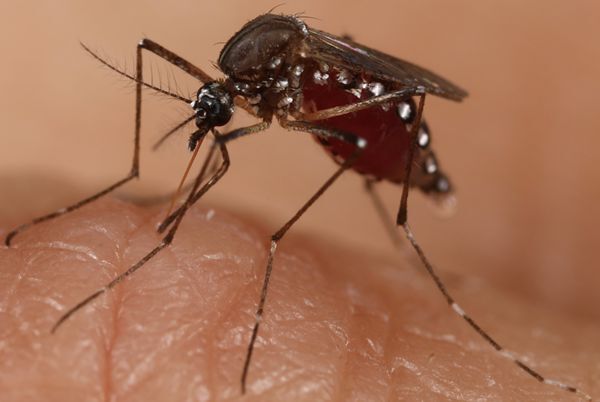
Pictured is a blood-feeding Aedes aegypti, the primary vector for the dengue and Zika viruses. (Image by ZHENG Aihua’s Lab)
<関連情報>
- http://english.ioz.cas.cn/ne/rp/202603/t20260318_1152886.html
- https://www.pnas.org/doi/10.1073/pnas.2511164123
ウイルスRNAのm6Aエピジェネティック修飾は、蚊媒介性フラビウイルスの伝播サイクルにとって極めて重要である m6A epigenetic modification of viral RNA is critical for the transmission cycle of mosquito-borne flaviviruses
Yanan Zhang, Lianglong Zhu, Yiran Yan, +4 , and Aihua Zheng
Proceedings of the National Academy of Sciences Published:March 18, 2026
DOI:https://doi.org/10.1073/pnas.2511164123
Significance
Arboviruses must adapt to divergent hosts to sustain their transmission cycles. N6-methyladenosine (m6A) modifications in mosquito-borne flaviviruses (MBFs), orchestrated by the dynamic interplay of SLI and G3BP1, are essential for viral propagation in vertebrates and transmission from vertebrates to mosquitoes. This study provides in-depth mechanistic details to understand the critical role of epigenetic modifications in flavivirus replication, with significant implications for flavivirology, epigenetics, and public health, and importantly, for the development of strategies to block flaviviral transmission.
Abstract
Arboviruses maintain alternative transmission routes between arthropods and vertebrates through precise dual-host adaptation of their viral genome. However, how epigenetic modifications impact flavivirus transmission cycle remains obscure. Depleting the m6A modification complex revealed that m6A modifications preferentially facilitate mosquito-borne flaviviruses (MBFs) propagation in vertebrates but not in mosquitoes. Stem loop I (SLI) deletion in the MBF 3’ UTR decreased m6A expression and viral propagation in vertebrates but not in mosquitoes, indicating viral genome component–epigenetic modification interplay. Mechanistically, m6A modification in stress granules was found to be driven by dynamic SLI–cellular G3BP1 interaction. The m6A-methylated viral genome is ejected by G3BP1 and undergoes viral assembly. Chemical perturbation of m6A modification via METTL3 inhibition potently blocked MBF proliferation in mice and abolished mouse–mosquito viral transmission. Overall, m6A modification is indispensable for efficient arthropod-to-vertebrate transmission of MBF, highlighting its potential as a target for antiviral and transmission-control strategies.

