2026-04-06 早稲田大学
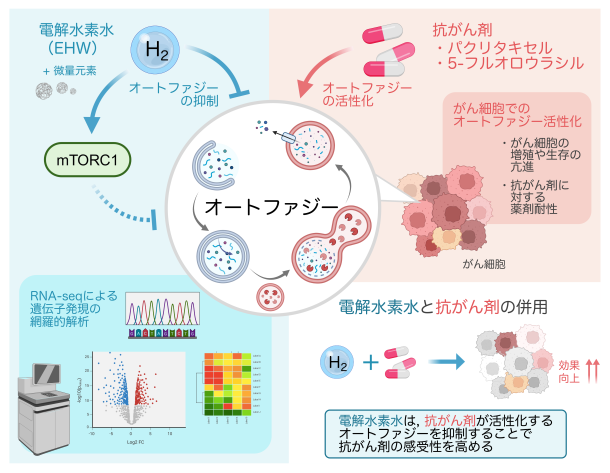
図: 抗がん剤および電解水素水がオートファジーに与える影響の作用モデル
<関連情報>
- https://www.waseda.jp/inst/research/news/83955
- https://onlinelibrary.wiley.com/doi/10.1111/jcmm.71011
電解水素水は、オートファジーを強力に抑制することにより、抗がん剤に対する化学感受性を向上させる Electrolyzed Hydrogen Water Improves Chemosensitivity to Anticancer Drugs by Potently Suppressing Autophagy
Satoshi Yano, Liangjing Xie, Jinjuan Li, Yuka Sugaya, Yuki Miyauchi, Shigeru Kabayama, Taichi Hara
Journal of Cellular and Molecular Medicine Published: 17 February 2026
DOI:https://doi.org/10.1111/jcmm.71011
ABSTRACT
Autophagy is an intracellular recycling system that contributes to the maintenance of cellular homeostasis. However, by providing tolerance to various stressors, autophagy promotes the survival and proliferation of cancer cells and confers resistance to chemotherapy. Anticancer drugs activate autophagy, leading to drug resistance in cancer cells. Autophagy inhibitors, such as chloroquine and hydroxychloroquine, enhance the antitumor effects of anticancer drugs when used in combination with them. However, these inhibitors are associated with several adverse effects. Here, using genome-wide RNA sequencing analysis, we deciphered a novel function of electrolyzed hydrogen water (EHW) in suppressing autophagy by activating mammalian target of rapamycin complex 1 signalling. The combination of EHW with anticancer drugs, such as 5-fluorouracil or paclitaxel, which activate autophagy, significantly decreased the viability of cervical and colorectal cancer cells. Mechanistically, molecular hydrogen and trace elements in EHW may suppress autophagy and potentiate anticancer effects. Considering its safety, we propose that EHW can act as a novel adjuvant to anticancer therapy.