2026-04-15 浙江大学(ZJU)
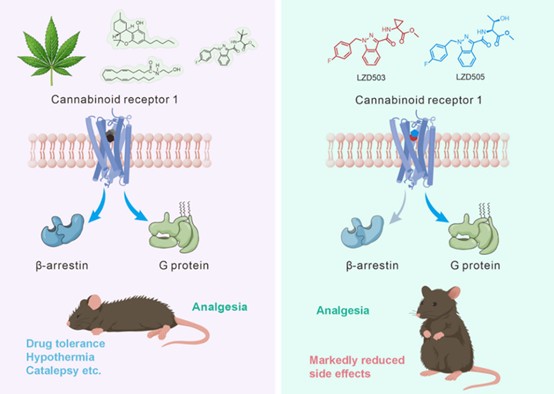
Comparison between traditional CB1 agonists and rationally designed biased small molecules.
<関連情報>
- https://www.zju.edu.cn/english/2026/0415/c19573a3151863/page.psp
- https://www.cell.com/cell/abstract/S0092-8674(26)00287-4
副作用を軽減したG iバイアスCB1アゴニストの合理的設計 Rational design of Gi-biased CB1 agonist with reduced side effects
Yu-Ying Liao ∙ Jinxin Che ∙ Yun-Tao Gao ∙ … ∙ Yan Zhang ∙ Xiaowu Dong ∙ Xiao-Ming Li
Cell Published:April 13, 202
DOI:https://doi.org/10.1016/j.cell.2026.03.020
Highlights
- An array of aromatic residues in CB1 is a key determinant for signaling bias
- Rational design of two Gi-biased CB1 agonists LZD503 and LZD505
- The agonists exhibit potent analgesic efficacy in diverse pain models
- The agonists display markedly reduced adverse effects in mice
Summary
The cannabinoid receptor 1 (CB1) has emerged as a promising candidate for next-generation non-opioid therapies. However, the development of therapeutics targeting CB1 has been consistently hindered by significant adverse effects. Here, through structure-activity relationship analyses focused on biased signaling, we rationally design two Gi-biased CB1 agonists, LZD503 and LZD505. Our design strategy employed structural spatial tuning of the agonist scaffold to disrupt specific molecular interactions and minimize steric conflicts with critical tip residues within the ligand-binding pocket, thereby promoting preferential Gi-pathway signaling. Cryo-electron microscopy structures of the CB1-G-protein complexes bound to these designed agonists confirmed that their anticipated conformational poses favored Gi-biased signaling. Both designed compounds demonstrated promising results by alleviating pain and mitigating unwanted responses in mice. The elucidated CB1 complex structures and the resulting insights establish a comprehensive framework for the structure-guided development of innovative CB1-targeted analgesics with reduced adverse effect profiles.