2026-04-21 京都大学
<関連情報>
- https://www.kyoto-u.ac.jp/ja/research-news/2026-04-21
- https://www.kyoto-u.ac.jp/sites/default/files/2026-04/web_2604_Jo-83887c10f0c077d5e0769f171d2a51e8.pdf
- https://onlinelibrary.wiley.com/doi/10.1111/bjh.70488
腎機能低下は、大細胞型B細胞リンパ腫に対するCAR-T細胞療法における重症サイトカイン放出症候群のリスク因子である Decreased renal function predicts severe cytokine release syndrome after CAR-T-cell therapy for large B-cell lymphoma
Yasuyuki Arai, Tomoyasu Jo, Takayuki Sato, Masatoshi Sakurai, Daisuke Kaji, Toshio Kitawaki, Kazuyuki Shimada, Tatsu Shimoyama, …
British Journal of Haematology Published: 15 April 2026
DOI: https://doi.org/10.1111/bjh.70488
Summary
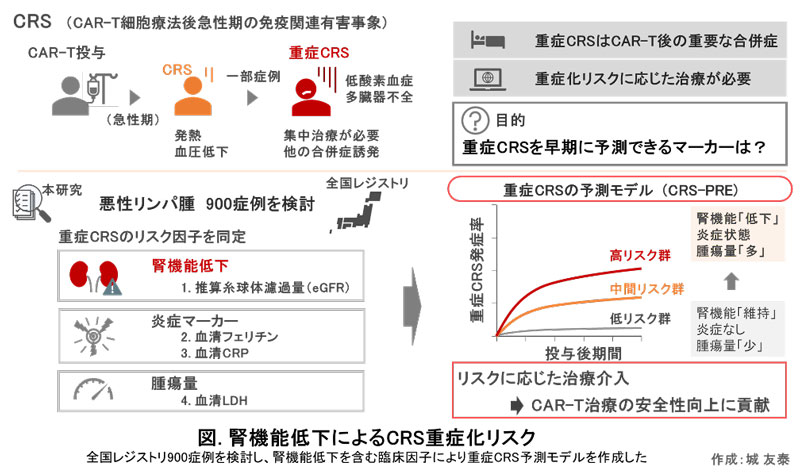
Cytokine release syndrome (CRS) remains a major toxicity of chimeric antigen receptor (CAR) T-cell therapy in large B-cell lymphoma (LBCL), and robust pre-infusion predictors are needed for risk-adapted management. We retrospectively analysed LBCL patients in the Japanese nationwide registry who underwent CD19 CAR-T-cell therapy between 2019 and 2024. Among 900 patients (median age 62 years), cumulative incidences of CRS within 30 days after infusion were 75.0% for any grade, 20.8% for grade ≥ 2 and 14.0% for grade ≥ 3. In multivariable analysis, lower estimated glomerular filtration rate (eGFR) (adjusted hazard ratio [aHR] 1.108 per 10 mL/min per 1.73 m2 decrease; 95% confidence interval [CI] 1.015–1.209; p = 0.022), higher ferritin (aHR 1.006 per 100 ng/mL; 95% CI 1.001–1.010; p = 0.016), C-reactive protein (CRP) (aHR 1.142 per mg/dL; 95% CI 1.091–1.195; p < 0.001) and lactate dehydrogenase (LDH) (aHR 1.073 per 100 U/L; 95% CI 1.008–1.142; p = 0.028) independently predicted grade ≥ 2 CRS. We then built a four-factor CRS pre-infusion risk evaluation model, cytokine release syndrome-pre-infusion risk evaluation (CRS-PRE), that stratified grade ≥ 2 CRS risk into low, intermediate and high groups with incidences of 2.8%, 26.0% and 50.0% respectively. Decreased eGFR, a surrogate of host renal reserve, with elevated ferritin, CRP and LDH emerged as predictors of high-grade CRS. The CRS-PRE may facilitate risk-adapted monitoring and intervention in clinical practice.