
2026-04-23 ブラウン大学
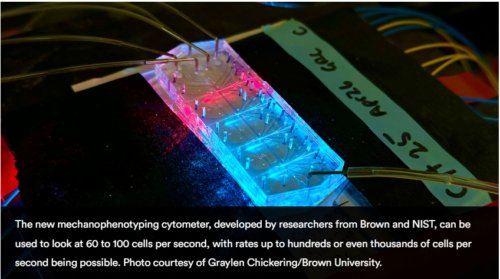
<関連情報>
- https://www.brown.edu/news/2026-04-23/cell-elasticity
- https://pubs.rsc.org/en/content/articlelanding/2026/lc/d5lc00930h
飛行時間および蛍光信号解析によるシリアルマイクロ流体サイトメーターでの単一細胞弾性率の推 Estimating single-cell elastic modulus in a serial microfluidic cytometer from time-of-flight and fluorescence signals analysis
Graylen R. Chickering,Leroy L. Jia,Matthew DiSalvo,Megan A. Catterton,Paul N. Patrone,Eric M. Darling and Gregory A. Cooksey
Lab on a Chip Published:21 Apr 2026
DOI:https://doi.org/10.1039/D5LC00930H
Abstract
Cellular state, function, and disease all contribute to whole-cell mechanical properties. Investigating these relationships is often difficult due to low measurement throughput, inability to draw one-to-one connections between mechanical and biochemical properties, and significant or unknown measurement uncertainty. To address these needs, we demonstrate that a serial microfluidic cytometer can realize high-throughput estimates of elastic modulus and size from fluorescence signals and time-of-flight (TOF) measurements of cell-like particles in flow. To analyze the resulting data, we leverage a combined spectral time-series analysis (STA) of fluorescence measurements and a mechanics-based Gaussian-process regression model. Critically, the former yields independent estimates of the particle size, whereas the latter characterizes the relationship between size, elasticity, and TOF, thereby allowing us to decouple such effects and extract estimates of elastic modulus. We calibrate the model using cell-like polyacrylamide microparticles with a range of known sizes (8.9 μm to 23 μm diameter) and stiffnesses (0.1 kPa to 9.1 kPa). The calibrated model is then applied to estimate the per-particle size and elastic modulus of live MG-63 osteosarcoma cells. Cell viability through the device was high (>90%), and the median diameter of 16.3 μm and elastic modulus of 0.9 kPa for MG-63s were consistent with light microscopy and AFM measurements. Thus, our novel device and model have the potential to expand mechanophenotyping capabilities by enabling high-throughput, single-cell measurements with uncertainty quantification. Furthermore, this emerging flow cytometry technique is directly compatible with fluorescence measurements of biochemical composition.

