2026-04-22 ロックフェラー大学
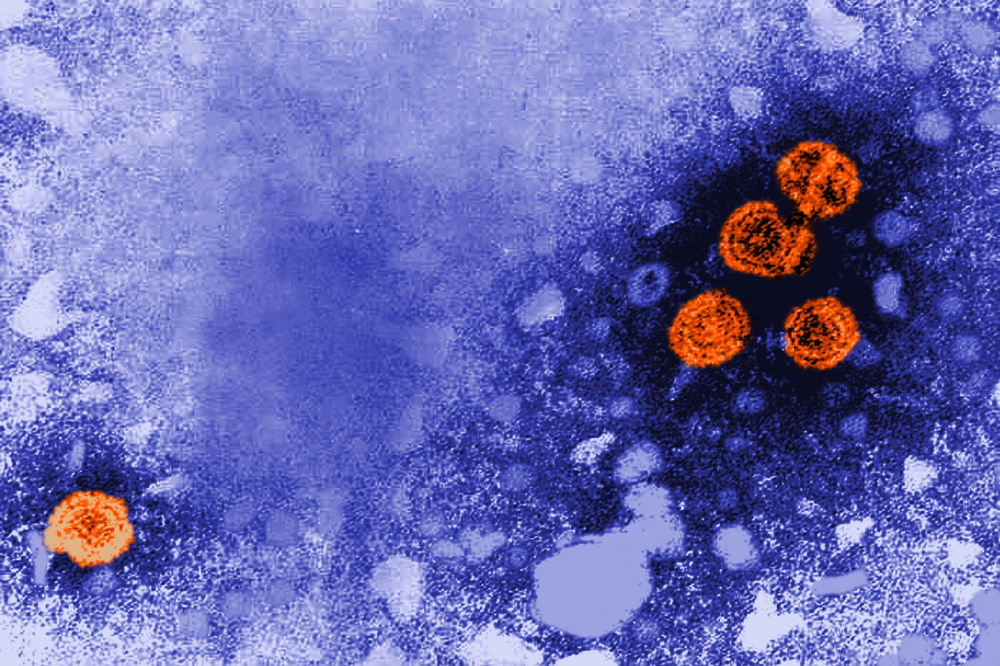
Transmission electron microscopic image showing hepatitis B virus virions in orange (Credit: CDC/Dr. Erskine Palmer)
<関連情報>
- https://www.rockefeller.edu/news/39445-mouse-model-hepatitis-b-therapies/
- https://www.pnas.org/doi/10.1073/pnas.2603476123
マウス肝細胞におけるB型肝炎ウイルスの共有結合閉環状DNA形成は、後期侵入阻害機構を明らかにする Hepatitis B virus covalently closed circular DNA formation in murine hepatic cells uncovers a late entry block
Xupeng Hong, Georgia Brousseau, Hsuan-An Chen, +7 , and Charles M. Rice
Proceedings of the National Academy Sciences Published:April 21, 2026
DOI:https://doi.org/10.1073/pnas.2603476123
Significance
Hepatitis B virus (HBV) chronically infects nearly 300 million people worldwide, but studies of its immunopathogenesis and therapeutics have been limited by the lack of an HBV-susceptible immunocompetent mouse model. A long-standing belief is that murine hepatocytes cannot form covalently closed circular DNA (cccDNA), the viral episome required for persistence. Here, we developed a piggyBac-based system to efficiently generate stable, inducible HBV-replicating cell lines and showed that murine hepatocytes can form cccDNA through the intracellular amplification pathway. Our results reveal that, beyond human HBV receptor expression, the dominant restriction occurs at a late entry step before nucleocapsid uncoating. Defining this remaining barrier will provide critical insights into HBV host tropism and help guide the development of fully HBV-permissive mouse models.
Abstract
Chronic hepatitis B virus (HBV) infection affects nearly 300 million people worldwide. Progress in understanding HBV immunopathogenesis and developing curative therapies has been hindered by the lack of suitable small animal models. HBV exhibits strict host and tissue tropism, with productive infection largely restricted to human and chimpanzee hepatocytes. Murine hepatocytes are resistant to HBV infection, even with ectopic expression of the human HBV entry receptor sodium taurocholate cotransporting polypeptide (huNTCP), because they apparently fail to form covalently closed circular DNA (cccDNA), the viral episome required for productive infection and persistence. To investigate the mechanisms restricting HBV infection in murine cells, we developed a piggyBac transposon-based system that efficiently generates inducible stable cell lines supporting HBV replication and cccDNA formation via intracellular amplification—a pathway that shares similar nucleocapsid uncoating and nuclear import of relaxed circular DNA (rcDNA) that occur during de novo infection. Remarkably, all tested murine hepatocyte and hepatoma cell lines, across multiple mouse genetic backgrounds, supported cccDNA formation at levels comparable to human cells, indicating that nucleocapsid uncoating and rcDNA nuclear import are not limited in mice. Given that huNTCP-expressing murine hepatocytes support hepatitis D virus infection, which shares early entry events with HBV, our findings reveal that the dominant restriction to HBV infection in huNTCP-expressing murine hepatocytes lies at a late entry step preceding nucleocapsid uncoating. By defining this mechanistic block, our study advances understanding of HBV host tropism and provides a foundation for facilitating development of fully HBV-susceptible mouse models.