2026-05-19 名古屋大学
<関連情報>
- https://www.nagoya-u.ac.jp/researchinfo/result/2026/05/post-996.html
- https://www.nature.com/articles/s41746-026-02665-8
疾患進行速度と経路における異質性の分解 Decomposing heterogeneity in disease progression speeds and pathways
Yuichiro Yada & Honda Naoki
npj Digital Medicine Published:12 May 2026
DOI:https://doi.org/10.1038/s41746-026-02665-8 Unedited version
Abstract
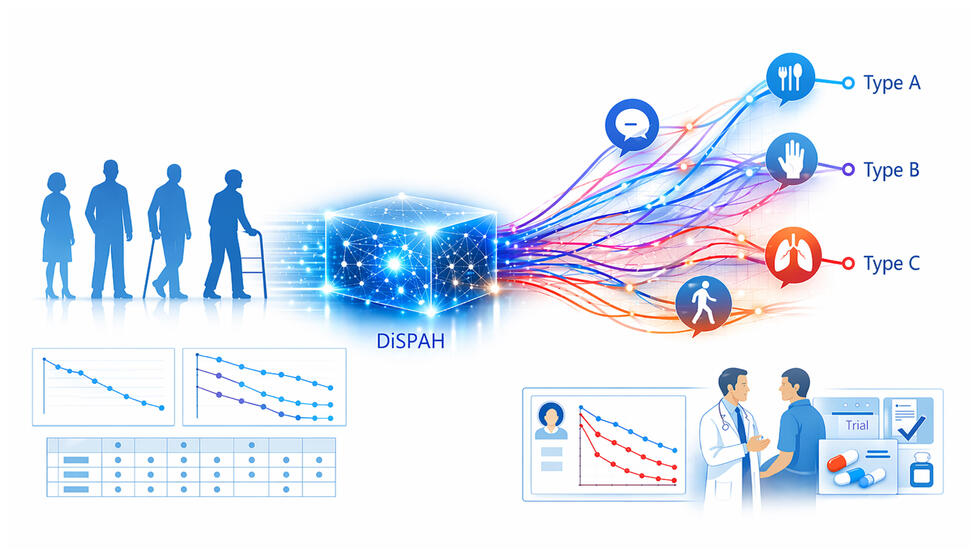
Understanding why patients with the same diagnosis exhibit markedly different disease progression—some rapidly, others slowly, with distinct symptom patterns—remains a major challenge in medicine. Here, we developed a machine learning framework called DiSPAH (Disease-progression Speed and Pathway Analysis based on a Hidden Markov model) to estimate both the pathway and speed of disease progression in individual patients. DiSPAH models disease progression as continuous-time transitions among latent disease states with a patient-specific progression speed. We applied DiSPAH to longitudinal clinical scores from an amyotrophic lateral sclerosis (ALS) cohort and inferred each patient’s trajectory of the latent disease states and progression speed. These dynamics were associated with baseline clinical features and enabled prediction of future course from first-visit data. Our results highlight that jointly modeling progression pathway and speed improves prediction of heterogeneous disease courses, offering a powerful tool for personalized care and research in ALS and other chronic conditions.