
2026-05-19 マサチューセッツ大学アマースト校
 <関連情報>
- https://www.umass.edu/news/article/over-half-type-2-diabetes-cases-could-be-preventable-umass-amherst-led-study-suggests
- https://diabetesjournals.org/diabetes/article/75/5/860/164687/Associations-of-Combined-Genetic-and-Lifestyle
英国バイオバンクにおける遺伝的リスクと生活習慣リスクの複合と2型糖尿病発症との関連性Associations of Combined Genetic and Lifestyle Risks With Incident Type 2 Diabetes in the UK Biobank
Chi Zhao;Konstantinos Hatzikotoulas;Raji Balasubramanian;Elizabeth Bertone-Johnson;Na Cai;Lianyun Huang;Alicia Huerta-Chagoya;Margaret Janiczek;Chaoran Ma;Ravi Mandla;Amanda Paluch;Nigel W. Rayner;Lorraine Southam;Susan R. Sturgeon;Ken Suzuki;Henry J. Taylor;Nicole Vankim;Xianyong Yin;Chi Hyun Lee;Francis Collins;Cassandra N. Spracklen
Diabetes Published:April 20 2026
DOI:https://doi.org/10.2337/db25-0672
Graphical Abstract
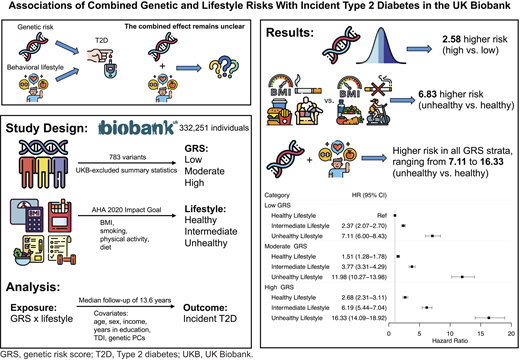
Type 2 diabetes (T2D) results from the interplay of genetic susceptibility and an unhealthy lifestyle, but their combined effects are not well studied. We examined whether unhealthy modifiable behaviors were associated with similar increases in the risk of incident T2D in individuals with different levels of genetic risk. Among 332,251 UK Biobank participants without diabetes, we constructed a multiancestry genetic risk score (GRS) based on 783 T2D-associated variants, categorized into tertiles. Lifestyle was classified as healthy, intermediate, or unhealthy based on baseline self-reported smoking status, BMI, physical activity level, and diet quality. Cox proportional hazards regression models were used to generate adjusted hazard ratios (HRs) for T2D and associated 95% CIs. During follow-up (median 13.6 years), 13,128 (4.0%) participants developed T2D. GRS (P < 0.001) and lifestyle classification (P < 0.001) were independently associated with increased risk of T2D. Compared with a healthy lifestyle, an unhealthy lifestyle was associated with increased risk in all genetic risk strata, with adjusted HRs ranging from 7.11 to 16.33. High genetic risk and an unhealthy lifestyle were the most significant contributors to T2D development. Individuals at all levels of genetic risk can substantially mitigate their T2D risk through lifestyle modifications.
Article Highlights
- Both genetic susceptibility and an unhealthy lifestyle are known to be associated with elevated type 2 diabetes (T2D) risk. However, their combined effects on T2D risk are not well studied.
- In this large prospective cohort study of more than 332,000 individuals, unhealthy lifestyle factors were associated with risk of incident T2D within and across different levels of genetic risk.
- These findings suggest individuals at all levels of genetic risk can greatly mitigate their risk of T2D by adhering to a healthy lifestyle.

