2026-06-04 カロリンスカ研究所(KI)
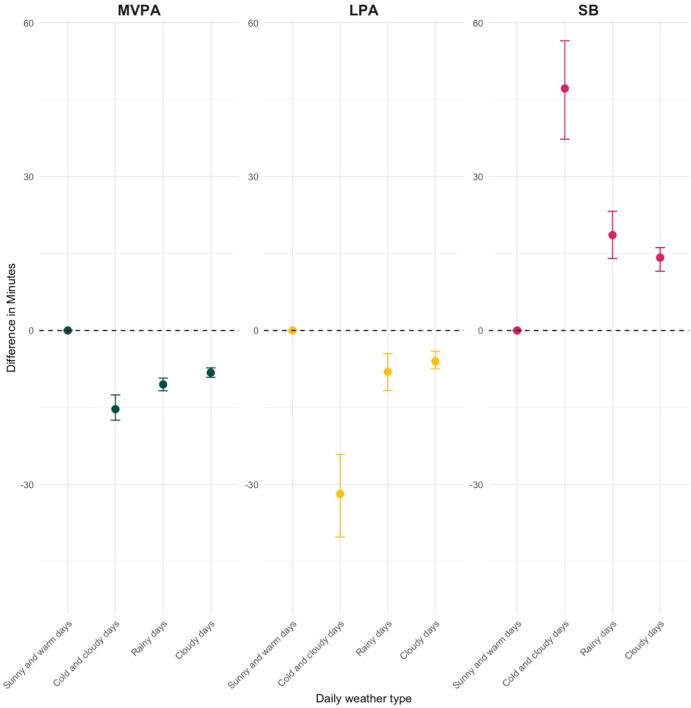
◆研究では、活動量計を用いて子どもの身体活動を客観的に測定し、気温や降水量、日照時間などの気象データと比較した。その結果、暖かく晴れた日には身体活動量が増加し、寒冷な日や降雨時には活動量が低下する傾向が確認された。特に屋外活動の機会が制限される悪天候では、活発な運動時間が短くなることが示された。一方で、保育施設の環境や活動プログラムによっては、天候の影響をある程度緩和できる可能性も示唆された。研究者らは、幼児期の身体活動が健康な成長や将来の生活習慣形成に重要であることから、天候条件に左右されにくい運動機会の確保や保育環境の工夫が必要であると指摘している。本研究は、幼児の健康促進政策や保育施設における運動プログラム設計の科学的根拠を提供するものである。
<関連情報>
- https://news.ki.se/weather-affects-preschool-childrens-activity-levels
- https://www.sciencedirect.com/science/article/pii/S0013935126012338
Sunny days, cloudy behavior? Associations between weather patterns and movement behaviors in preschoolers using compositional data analysis
Pablo Campos-Garzón, Per Tynelius, Michael Lundberg, Charlotte Wilén, Viktor H. Ahlqvist, Jairo H. Migueles, Martin Neovius, Pontus Henriksson, Micael Dahlen, Cecilia Magnusson, Daniel Berglind
Environmental Research Available onlin:e 2 June 2026
DOI:https://doi.org/10.1016/j.envres.2026.124902

Highlights
- Daily weather profiles were associated with preschoolers’ movement behaviors.
- Cold and cloudy days were linked to less physical activity and more sedentary time.
- Weather effects were stronger on weekends and did not differ by gender.
- Weather clustering and compositional analysis provide a novel analytical framework.
Abstract
Purpose
To investigate associations between daily weather conditions and movement behaviors (moderate-to-vigorous physical activity [MVPA], light physical activity [LPA], and sedentary behavior [SB]) in Swedish preschool children, and whether these differed by sex and day type (weekdays vs. weekends).
Methods
A total of 3307 preschool children (4.5 ± 0.9 years; 48.6% girls) wore accelerometers to measure daily MVPA, LPA, and SB during 14 days across two periods. Weather data (temperature, sunshine, daylight duration, precipitation, and snow) were obtained from the Swedish Meteorological and Hydrological Institute. Principal component analysis followed by k-means clustering classified days into weather categories. Compositional data analysis using isometric log-ratio transformation and linear mixed-effects models estimated associations, with predictions back-transformed to minutes/day using bootstrap procedures.
Results
Four weather clusters were identified: sunny and warm, cold and cloudy, rainy, and cloudy days. Weather clusters were significantly associated with daily movement composition (p = 0.001). Compared with sunny and warm days, cold and cloudy days were associated with −15.1 min MVPA, −32.0 min LPA, and +46.5 min SB. Rainy days showed −11.0 min MVPA, −8.3 min LPA, and +19.4 min SB, while cloudy days showed −8.3 min MVPA, −7.2 min LPA, and +15.6 min SB. Sex interactions were not significant (p > 0.05). In contrast, day type significantly modified associations for cold and cloudy and rainy days (p < 0.001), with larger reductions in PA on weekends.
Conclusion
Daily weather conditions were significantly associated with the movement-behavior composition of Swedish preschool children. These findings demonstrate how short-term environmental variability can substantially influence young children’s daily activity patterns. Recognizing weather as a dynamic environmental exposure is therefore essential for accurately interpreting movement behavior data and for understanding how environmental conditions shape human activity patterns in early childhood.