2026-06-11 バッファロー大学(UB)
<関連情報>
- https://www.buffalo.edu/news/releases/2026/06/early-warning-system-extreme-heat.html
- https://www.nature.com/articles/s41558-026-02642-9
- https://www.nature.com/articles/s41559-023-02070-4
生物多様性が極端な高温にさらされることを予測するための世界的な早期警報システム A global early warning system for predicting exposure of biodiversity to extreme heat
Josep M. Serra-Diaz,Lauren C. Andrews,Andreas Schwarz Meyer,Ben S. Carlson,Brian Maitner,Gonzalo E. Pinilla-Buitrago,Alex L. Pigot,Christopher H. Trisos,Adam M. Wilson,Mark C. Urban & Cory Merow
Nature Climate Change Published:08 June 2026
DOI:https://doi.org/10.1038/s41558-026-02642-9
Abstract
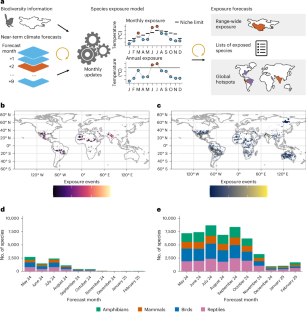
Effective biodiversity conservation during periods of rapid environmental change requires identifying the species and regions at greatest risk. However, most predictions focus on biodiversity shifts several decades ahead, offering limited guidance for immediate conservation action. Here we develop an early warning system for biodiversity based on 9-month seasonal weather forecasts combined with species-specific historical temperature limits. In May 2024, we predicted that >3,500 vertebrate species (out of 30,585 species), including >1,250 species of conservation concern, would be substantially exposed to extreme temperatures 1–2 months in advance on average. Mexico, Sub-Saharan Africa and the Himalayas were predicted to face the highest threats during this forecast period. Early evidence suggests that exposure in these regions likely negatively impacted some species populations. Such advance notice can enable rapid actions to monitor and mitigate these extreme events for sensitive species and regions.
気候変動が世界中の種に及ぼすリスクの急激な拡大 Abrupt expansion of climate change risks for species globally
Alex L. Pigot,Cory Merow,Adam Wilson & Christopher H. Trisos
Nature Ecology & Evolution Published:18 May 2023
DOI:https://doi.org/10.1038/s41559-023-02070-4
Abstract
Climate change is already exposing species to dangerous temperatures driving widespread population and geographical contractions. However, little is known about how these risks of thermal exposure will expand across species’ existing geographical ranges over time as climate change continues. Here, using geographical data for approximately 36,000 marine and terrestrial species and climate projections to 2100, we show that the area of each species’ geographical range at risk of thermal exposure will expand abruptly. On average, more than 50% of the increase in exposure projected for a species will occur in a single decade. This abruptness is partly due to the rapid pace of future projected warming but also because the greater area available at the warm end of thermal gradients constrains species to disproportionately occupy sites close to their upper thermal limit. These geographical constraints on the structure of species ranges operate both on land and in the ocean and mean that, even in the absence of amplifying ecological feedbacks, thermally sensitive species may be inherently vulnerable to sudden warming-driven collapse. With higher levels of warming, the number of species passing these thermal thresholds, and at risk of abrupt and widespread thermal exposure, increases, doubling from less than 15% to more than 30% between 1.5 °C and 2.5 °C of global warming. These results indicate that climate threats to thousands of species are expected to expand abruptly in the coming decades, thereby highlighting the urgency of mitigation and adaptation actions.