2026-06-23 東北大学
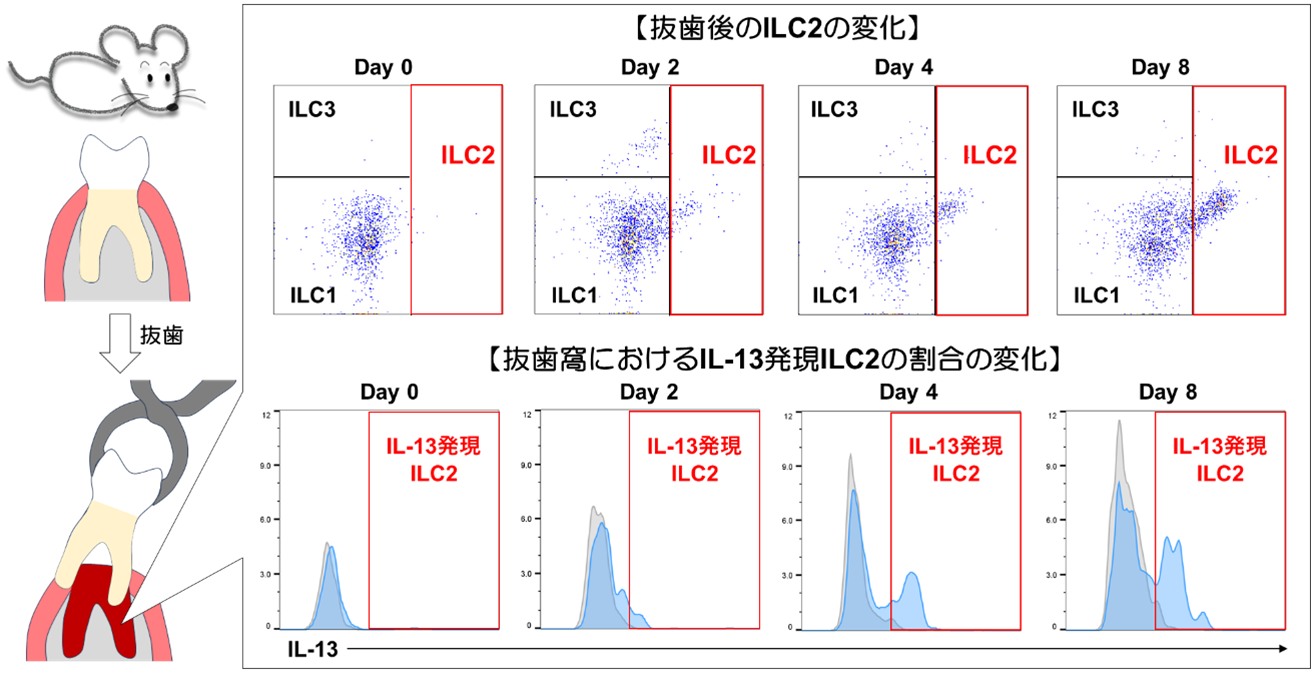
図1. 抜歯窩におけるILC2の数とIL-13産生の変化
<関連情報>
- https://www.tohoku.ac.jp/japanese/2026/06/press20260623-04-gingiva.html
- https://journals.sagepub.com/doi/10.1177/00220345261449746
IL-33–ILC2–IL-13経路を介した歯肉線維芽細胞による骨免疫学 Gingival Fibroblast-Driven Osteoimmunology via the IL-33–ILC2–IL-13 Axis
Y. Sato, T. Kondo , […], and H. Egusa
Journal of Dental Research Published:June 22, 2026
DOI:https://doi.org/10.1177/00220345261449746
Abstract
Tooth extraction is a fundamental dental intervention for managing oral infections; however, the resulting tooth loss is associated with systemic health risks, including cognitive decline and increased mortality. Alveolar bone resorption following tooth extraction significantly alters jaw morphology, complicating subsequent functional rehabilitation. Despite its clinical significance, the cellular and molecular mechanisms governing bone regeneration within extraction sockets remain poorly understood. Here, we identified group 2 innate lymphoid cells (ILC2s) as pivotal regulators of alveolar bone regeneration following tooth extraction. Using single-cell RNA sequencing and flow cytometry, we demonstrated that ILC2s accumulate and persist within extraction sockets beyond the acute inflammatory phase. Genetic lymphocyte ablation revealed that loss of all ILCs severely impairs bone formation, highlighting their essential role in socket regeneration. Following tooth extraction, ILC2s exhibited increased interleukin (IL)–13 production and promoted bone formation via IL-13–mediated activation of bone marrow–derived mesenchymal stromal cells. Single-cell RNA sequencing and histological analyses suggested that gingival fibroblasts are a major source of IL-33 in extraction sockets during mucosal healing. IL-33 activated ILC2s, increasing IL-13 production and promoting osteogenesis, whereas IL-33 neutralization suppressed ILC2 activation and impaired socket bone regeneration. Collectively, these findings suggest that the gingival fibroblast–IL-33–ILC2–IL-13 axis may contribute to the regulation of alveolar bone regeneration following tooth extraction. This study provides a biological basis for developing novel therapeutic strategies to optimize postextraction bone preservation.