2026-07-10 清華大学
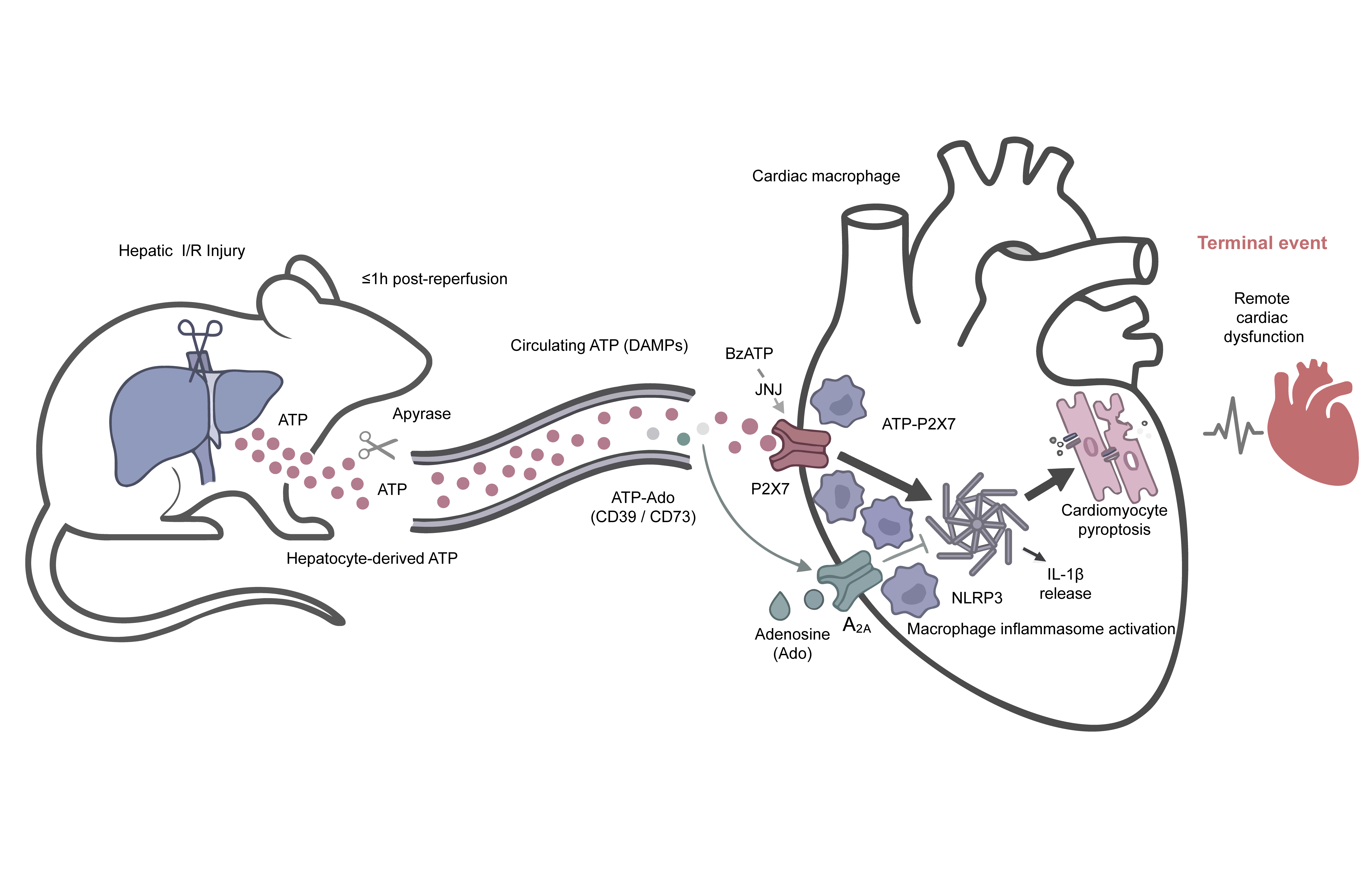
Schematic overview: liver-derived ATP drives remote cardiac injury via macrophage P2X7-NLRP3 inflammasome activation
<関連情報>
- https://www.tsinghua.edu.cn/en/info/1245/14989.htm
- https://www.sciencedirect.com/science/article/pii/S1043661826002215
肝虚血再灌流由来の循環ATPは、マクロファージインフラマソームの活性化を介して遠隔心臓障害を引き起こす Circulating ATP from hepatic ischemia-reperfusion drives remote cardiac injury via macrophage inflammasome activation
Zheng Zhang, Yi Duan, Fulei Gu, Jinyan Wei, Hongyu Huo, Yuze Wang, Dan Lu, Zhifeng Gao
Pharmacological Research Available online: 17 June 2026
DOI:https://doi.org/10.1016/j.phrs.2026.108306
Highlights
- MINS incidence rises from 20.5% to 50% with postoperative liver injury severity.
- Circulating ATP from ischemic liver is sufficient and necessary for cardiac injury.
- Macrophage P2X7-NLRP3 inflammasome drives cardiomyocyte pyroptosis after HIRI.
- Macrophage P2X7 gates cardiomyocyte pyroptosis as the dominant upstream node.
- Delayed P2X7 blockade up to 3 h post-reperfusion retains cardioprotection.
Abstract
Cardiac complications after major hepatic surgery are frequent, yet how hepatic ischemia-reperfusion injury (HIRI) damages the remote heart is unknown. In 382 hepatectomy patients, the incidence of myocardial injury after noncardiac surgery (MINS) rose from 20.5% to 50% with increasing postoperative liver damage severity (P < 0.0001). In a murine HIRI model, cardiac dysfunction lagged behind hepatic injury; circulating ATP surged within one hour of reperfusion from the ischemic liver and was both sufficient and necessary to drive remote cardiac damage. Extracellular ATP activated the P2X7 receptor on cardiac macrophages, triggering NLRP3 inflammasome assembly and gasdermin D (GSDMD)-dependent cardiomyocyte pyroptosis; siRNA-based dominant-gating co-culture identified macrophage P2X7 as the upstream gating step, with cardiomyocyte-side P2X7 knockdown failing to abrogate downstream pyroptosis. Single-cell profiling traced this program to monocyte-derived macrophages differentiating into inflammatory macrophages, and macrophages amplified hepatocyte-derived ATP into IL-1β-driven cardiomyocyte pyroptosis in vitro. Clodronate-mediated macrophage depletion preserved cardiac function. The selective P2X7 antagonist JNJ-47965567 polarized cardiac macrophages toward an anti-inflammatory phenotype and suppressed NLRP3-GSDMD pyroptosis when administered up to approximately 3 h after reperfusion onset, defining a clinically relevant therapeutic window. Adenosine activated the A2A receptor and attenuated cardiac injury dose-dependently, reversed by SCH-58261, and conferred greater cardiac protection than dexamethasone or N-acetylcysteine. These findings establish cardiac macrophages as amplifiers of liver-derived danger signals and identify the ATP-P2X7/adenosine-A2A purinergic axis as a potential pharmacological target for perioperative cardioprotection.