2026-07-13 エディンバラ大学
<関連情報>
- https://www.ed.ac.uk/news/novel-tech-could-aid-targeted-lung-cancer-treatment
- https://aacrjournals.org/cancerres/article-abstract/doi/10.1158/0008-5472.CAN-25-5589/786577/Label-Free-Prediction-of-EGFR-Mutation-Status
肺腺癌における蛍光寿命イメージングと深層学習を用いたEGFR変異状態のラベルフリー予測 Label-Free Prediction of EGFR Mutation Status Using Fluorescence Lifetime Imaging and Deep Learning in Lung Adenocarcinoma
Zhenya Zang;David A. Dorward;Sophie Ihuoma;Ahsan R. Akram;Qiang Wang
Cancer Research Published:July 13 2026
DOI:https://doi.org/10.1158/0008-5472.CAN-25-5589
Abstract
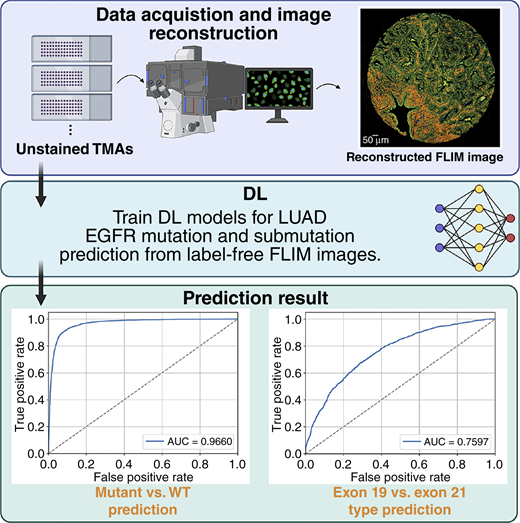
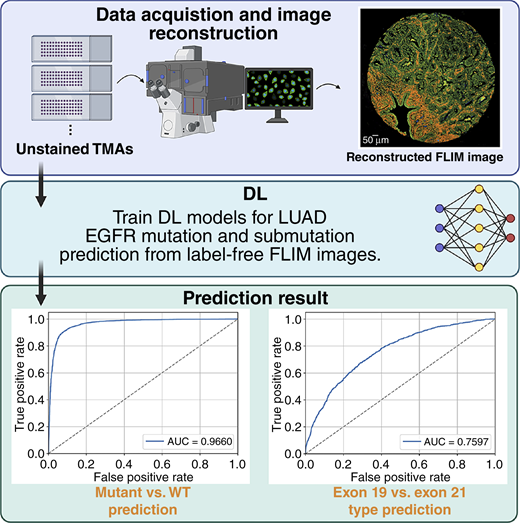
Accurate prediction of epidermal growth factor receptor (EGFR) mutations is essential for guiding targeted therapy in non–small cell lung cancer (NSCLC) and is routinely performed in clinical pathology samples. Current diagnostic practices rely on molecular techniques such as PCR-based assays and next-generation sequencing, which are often costly, time-consuming, and destructive to tissue samples. Furthermore, in NSCLC diagnostics, a common limitation is the availability of sufficient tissue to support comprehensive pathologic and molecular characterization, highlighting the need for noninvasive, predictive approaches to identify EGFR mutations. Recent advances in computational pathology have enabled the rapid prediction of EGFR mutations from histopathologic images using deep learning (DL), demonstrating promising performance. However, these methods still depend on conventional tissue staining. In this study, we developed a DL-based nondestructive, label-free approach for rapid and accurate EGFR mutation prediction using fluorescence lifetime imaging (FLIM). Unlike existing methods, this approach eliminated the need for histologic staining and molecular testing, and it achieved state-of-the-art area under the receiver operating characteristic curve scores of 0.966 on label-free FLIM images. This strategy also provided accurate classification of the two most common NSCLC EGFR mutations of exon 19 deletion and exon 21 point mutation across the dataset. Together, this work demonstrates the strength of label-free FLIM images for mutation prediction, which could significantly reduce clinical overhead associated with lengthy gene sequencing and staining procedures to accelerate practical, nondestructive mutation prediction.