2026-07-27 エディンバラ大学
<関連情報>
- https://www.ed.ac.uk/news/new-clues-to-long-standing-cancer-mystery
- https://www.nature.com/articles/s41586-026-10821-z
遺伝的背景が実験的癌の進化の軌跡を決定づける Genetic background sets the trajectory of experimental cancer evolution
Sarah J. Aitken,Frances Connor,Christine Feig,Tim F. Rayner,Margus Lukk,Juliet Luft,Stuart Aitken,Claudia Arnedo-Pac,James F. Hayes,Michael D. Nicholson,Ailith Ewing,Vasavi Sundaram,Jan C. Verburg,John Connelly,Craig J. Anderson,Mikaela Behm,Susan Campbell,Maëlle Daunesse,Vera B. Kaiser,Elissavet Kentepozidou,Oriol Pich,Aisling M. Redmond,Javier Santoyo-Lopez,Inés Sentís,Liver Cancer Evolution Consortium,… Duncan T. Odom
Nature Published:22 July 2026
DOI:https://doi.org/10.1038/s41586-026-10821-z
Abstract
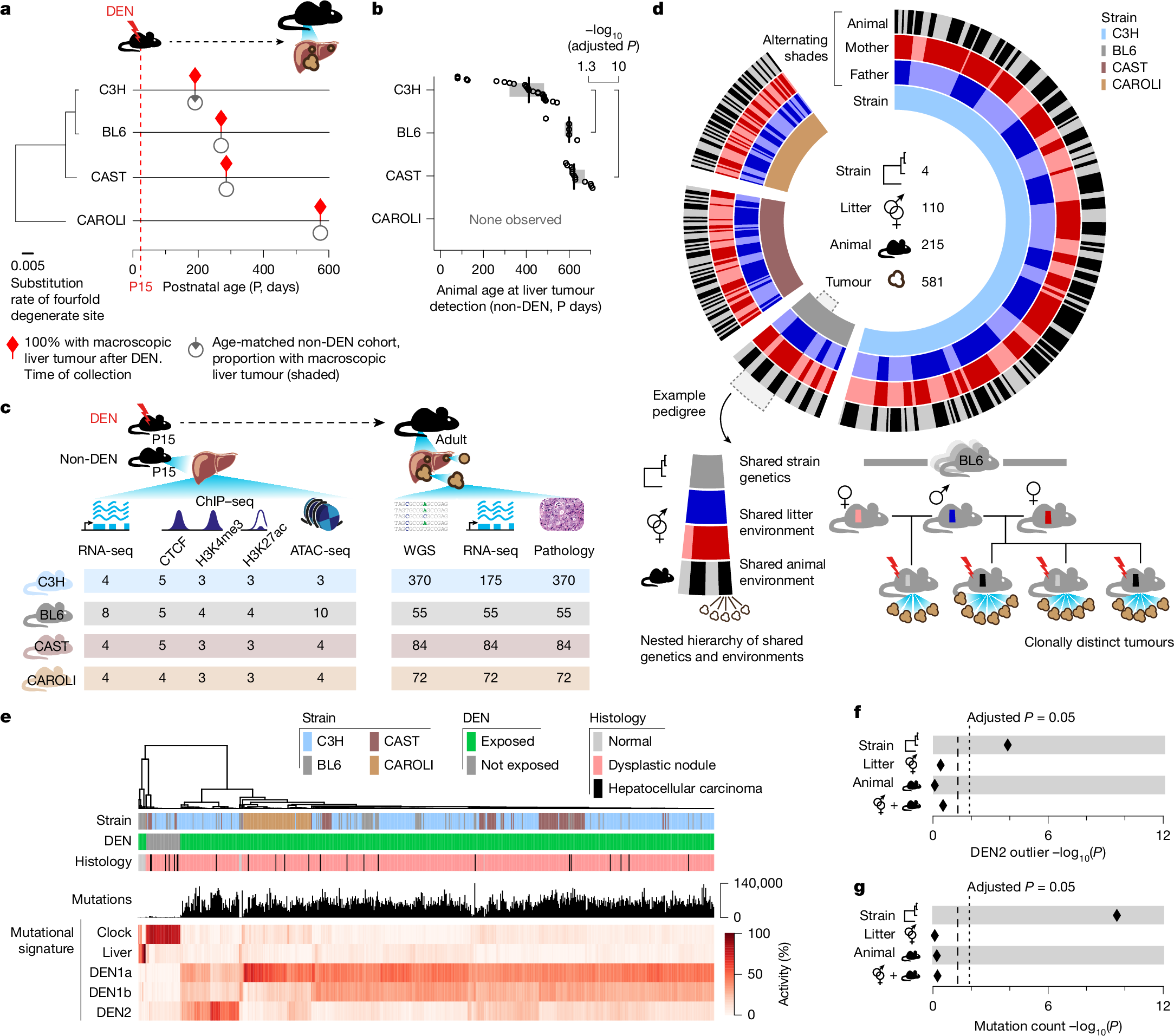
Human cancers are heterogeneous1. Dissecting how germline genetic variation and environmental factors shape tumour evolution using human datasets is limited by inherent diversity in genetic backgrounds2 and environmental exposures3,4,5. Here, to overcome these limitations, we re-ran early tumour evolution hundreds of times in diverged inbred mouse strains, generating matched histology and whole-genome and transcriptome sequences. The sex, environment and carcinogenic exposures were all controlled, and the study design allowed us to capture genetic variation comparable with that observed across human populations while exploiting the nested hierarchical structure of strain–litter–animal–tumour relationships. Our analyses reveal that epistatic interactions between genetic background and acquired somatic mutations result in population-specific disease progression, including choice of driver mutations, occurrence of whole-genome duplication and subclonal selection dynamics that mirror both cancer susceptibility and tumour growth rate. Even modest genetic divergence, comparable with that found across human ancestry groups, can strikingly alter selection pressures during cancer development to shape both cancer risk and the trajectory of tumour evolution.