2026-10-28 マサチューセッツ工科大学(MIT)
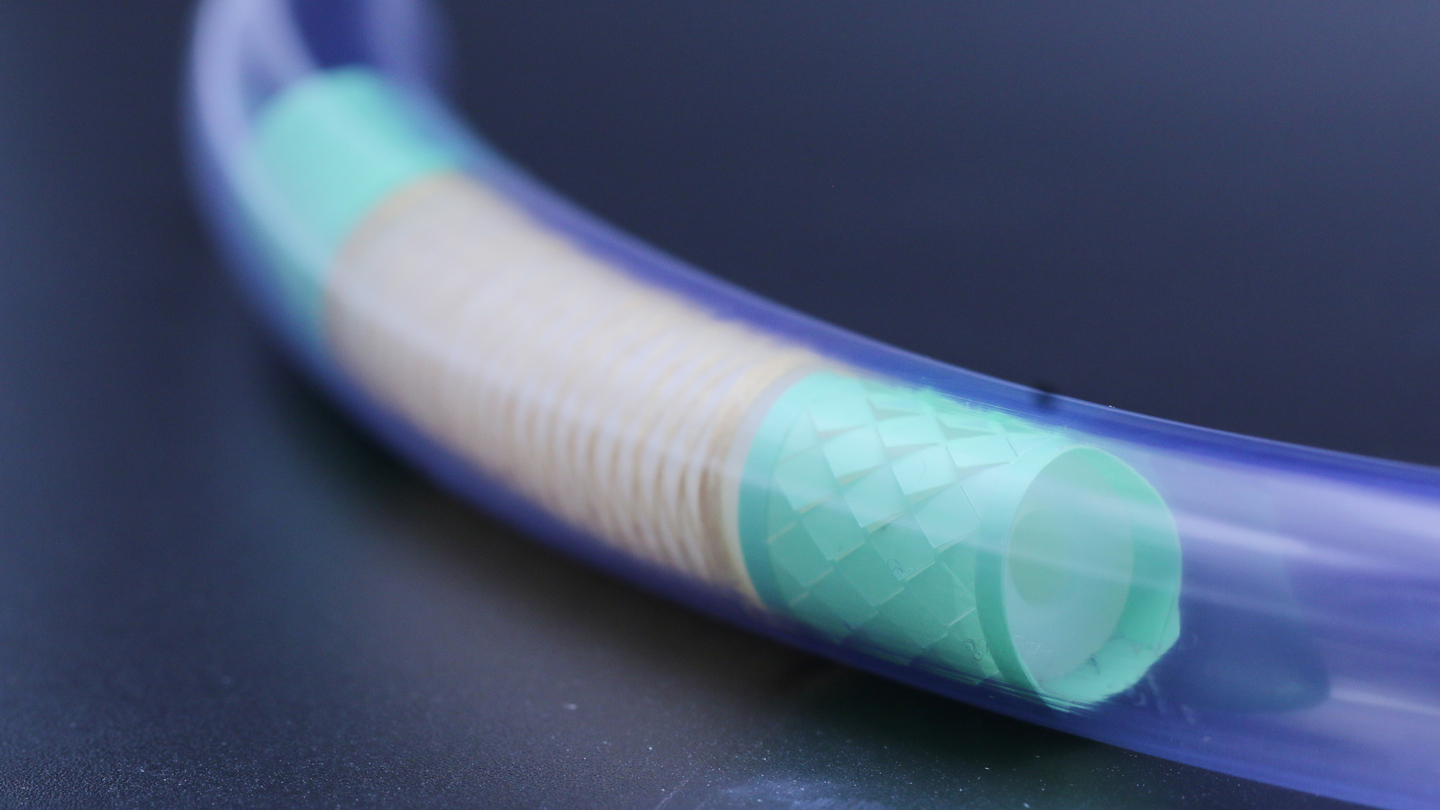
“When we evaluate the small intestine, we do it for either diagnosis or treatment. If we find a little polyp that needs to be removed, this robot allows us to take a biopsy or remove it,” says Giovanni Traverso. Credit: Courtesy of the researchers
<関連情報>
- https://news.mit.edu/2026/soft-robot-could-help-doctors-diagnose-treat-small-intestine-disorders-1028
- https://www.science.org/doi/10.1126/scirobotics.adt2230
生体模倣型軟性腸管内視鏡ロボットによる腸管内移動、操縦、および介入 Bioinspired soft enteroscopic robot for intestinal locomotion, steering, and intervention
Binbin Ying, Ahmad Mujtaba Jebran, Sahab Babaee, Karen Jiang, Brenda D. Fernandez Martinez, Haniyah Shareef, Mohammed Talha Faiz, Andrew Pettinari, Kailyn Schmidt, […] , and Giovanni Traverso
Science Robotics Published:28 Oct 2026
DOI:https://doi.org/10.1126/scirobotics.adt2230
Abstract
Diagnosing and treating small intestinal disorders such as bleeding, inflammatory bowel disease, and tumors present challenges because of limited access to this anatomical compartment. We present BIOSENTER, a bioinspired soft enteroscopic robot for deep procedures in the small intestine that addresses locomotion, steering, and intervention constraints of existing soft robotic systems. BIOSENTER features a hollow cylinder architecture comprising a linearly deformable soft pneumatic actuator as the body, two radially expandable soft pneumatic actuators wrapped with kirigami sleeves as the head and tail, a central hollow channel for accessory endoscopic tools, and a control box for navigation. Inspired by snake locomotion, the robotic body incorporates a fiber-reinforced actuator with four embedded inflatable chambers, enabling steering and axial expansion. The dynamic kirigami sleeves generate an anchoring force of ∼1.5 newtons on intestinal mucosa while requiring substantially less radial expansion than the corresponding nonkirigami configuration. A reinforced central channel supports tool passage for diagnostic and therapeutic interventions. The control box enables locomotion and steering at autonomous speeds of ∼100 millimeters per minute in vitro and ∼43 millimeters per minute in tissue-covered tubing. BIOSENTER successfully navigated the collapsed, tortuous small intestine for 2 meters in 11 minutes, with gentle forward pushing forces of 2.2 to 6.4 newtons in pig studies. In vivo pig studies demonstrated technical feasibility of tissue biopsy, localized fluid delivery as a model for future drug administration, and real-time visualization of the deep intestine, without macroscopic overdistention or visible tissue damage under the tested conditions.