2026-11-04 国立精神・神経医療研究センター
<関連情報>
- https://www.ncnp.go.jp/topics/detail.php?@uid=d6fSSzq61PhGSIWZ
- https://www.nature.com/articles/s41598-026-76138-z
マーモセットの自閉症モデルでは、近距離での視線反応性の亢進と相互視線の不安定性が、二者間協調の特徴となっている Heightened gaze responsiveness and mutual gaze instability at close distances characterize dyadic coordination in a marmoset model of autism
Madoka Nakamura, Tomoko Sato, Tohru Kurotani, Kazuhisa Sakai, Anna Hadjiev, Shuntaro Sasai, Koki Mimura, Nobuyuki Kawai, Tsuyoshi Shimmura & Noritaka Ichinohe
Scientific Reports Published:28 October 2026
DOI:https://doi.org/10.1038/s41598-026-76138-z Early provide
Abstract
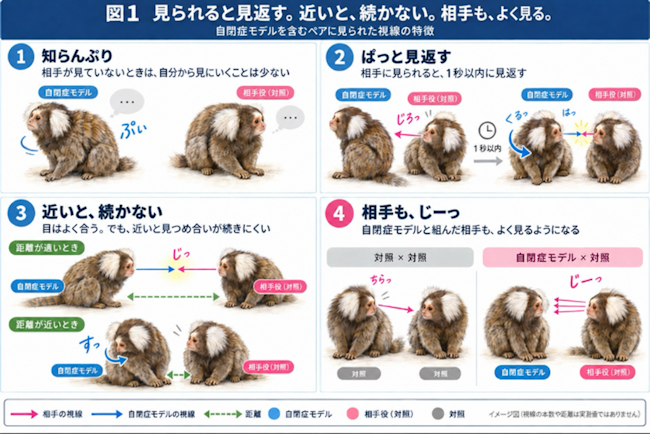
Autism spectrum disorder (ASD) is associated with differences in social interaction, including alterations in gaze behavior and interpersonal distance. Although most assessments of ASD remain individual-centric, emerging human studies indicate that social difficulties may arise from atypical dyadic coordination rather than from reduced social interest alone. We examined dyadic coordination in a non-human primate model of ASD, focusing on gaze and inter-individual distance during minimally constrained first encounters between prenatal valproic acid-exposed marmosets (VPA) and unexposed conspecifics (UE). Markerless pose estimation quantified frame-by-frame gaze direction and spacing, comparing VPA–UE with UE–UE dyads. VPA–UE pairs exhibited a higher proportion of mutual-gaze events than UE–UE pairs. VPA individuals showed more rapid looks in response to the partner’s gaze, yet exhibited a lower proportion of one-sided looking events. VPA–UE dyads maintained shorter inter-individual distances than UE–UE dyads, and closer spacing was associated with decreased stability of mutual gaze. These findings reveal a dyadic coordination pattern in VPA–UE pairs, with rapid responsiveness coupled with a distance-dependent reduction in time spent in mutual gaze, paralleling features reported in human ASD. Our dyad-centric, markerless framework yields ecologically grounded readouts and potential intervention targets that leverage intact social responsiveness while accommodating altered spatial coordination.