2026-11-02慶應義塾大学医学部,東京科学大学,静岡大学
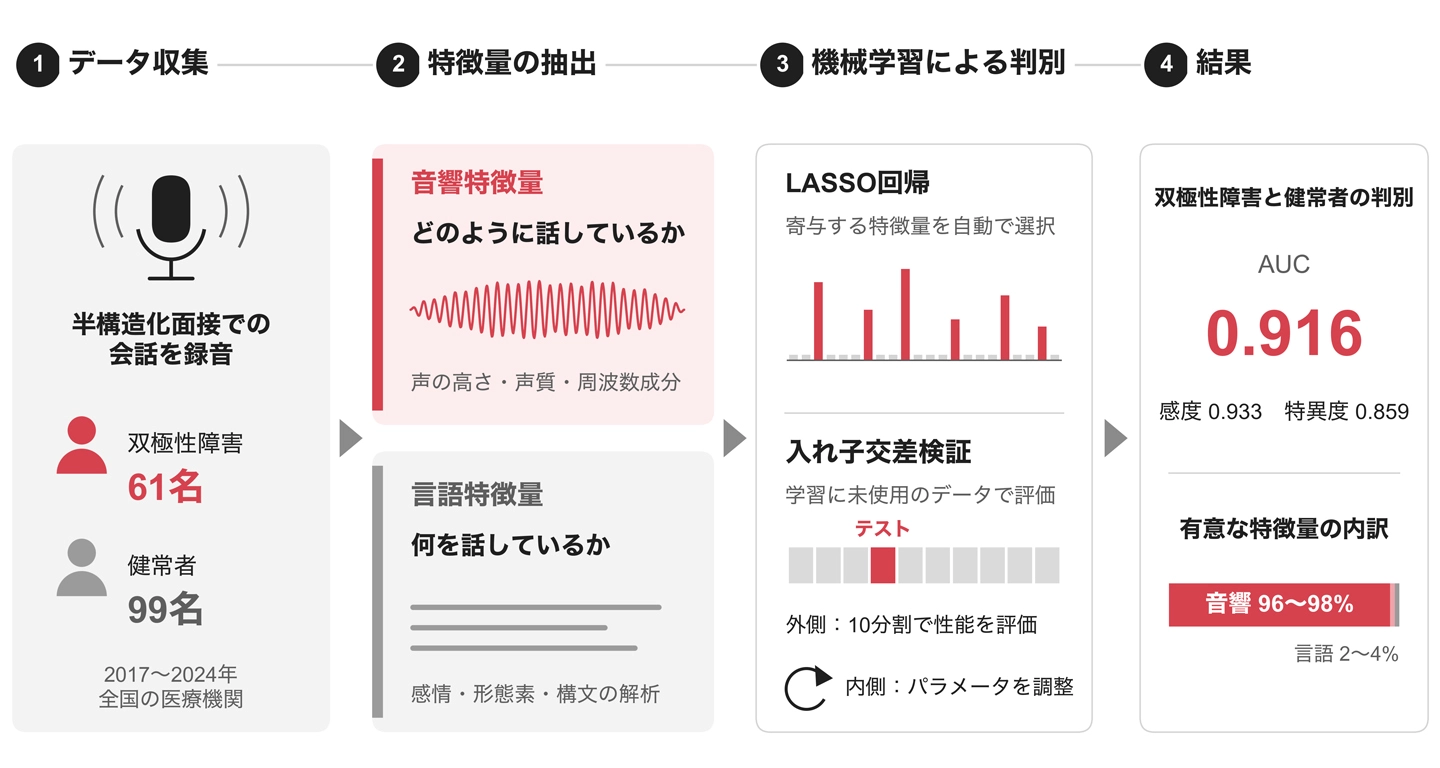
図1.本研究の概要
<関連情報>
- https://www.keio.ac.jp/ja/press-release/20261102-press-01/
- https://www.keio.ac.jp/fixed-files/20261102-press-01-e76gaqsm.pdf
- https://www.jmir.org/2026/1/e98094
自然言語処理と音声解析を用いた、気分状態をまたぐ双極性障害の機械学習による判別:観察研究 Machine Learning Classification of Bipolar Disorder Across Mood States Using Natural Language Processing and Speech Analysis: Observational Study
Yusei Yamaguchi; Yoshinobu Kano; Genichi Sugihara; Ryo Takemura; Hironobu Nakamura; Masaaki Shimizu; Mari Iizuka; Momoko Kitazawa; Ayako Sento; Hidehiko Takahashi; Taishiro Kishimoto
Journal of Medical Internet Research Published: 14.Apr.2026
DOI:https://doi.org/10.2196/98094
Abstract
Background:Bipolar disorder (BP) affects 1% to 3% of adults worldwide, with diagnostic delays averaging 6 years and high initial misdiagnosis rates. The absence of objective diagnostic measures contributes to clinical uncertainty and suboptimal outcomes.
Objective:This study aimed to (1) develop a machine learning model for BP diagnosis and mood state classification using linguistic and acoustic features, (2) identify features associated with different mood states by comparing each with healthy controls (HC), and (3) explore whether features distinguish between mood states within BP.
Methods:We analyzed data prospectively collected over 7 years from 61 patients with BP and 99 HC across Japan. Speech samples were collected via semistructured interviews over 1 to 5 visits and analyzed cross-sectionally, using aggregated or single-visit observations per participant rather than within-person longitudinal modeling. We extracted 6373 acoustic features (openSMILE 3.0, ComParE 2016) and 211 linguistic features. Least absolute shrinkage and selection operator (LASSO)–regularized logistic regression with nested cross-validation and age- and sex-matched undersampling was used. Mood states were classified as depressive state (DS; Hamilton Depression Rating Scale-17 [HAMD-17] ≥8, Young Mania Rating Scale [YMRS] ≤7), state with manic/mixed symptoms (MS/MX; YMRS ≥8), or euthymic state (ES; HAMD-17 ≤7, YMRS ≤7). Seven classification tasks included BP vs HC, each mood state vs HC, and interstate comparisons. Feature importance was validated via permutation testing (P<.05). Medication sensitivity analyses were performed.
Results:The model achieved high discrimination for BP vs HC (area under the receiver operating characteristic curve [AUC]=0.916, 95% CI 0.854‐0.958; sensitivity 0.933; specificity 0.859) and strong performance for mood states vs HC (AUC=0.805‐0.874). Acoustic features comprised 96% to 98% of the features achieving statistical significance (P<.05), including mel-frequency cepstral coefficients, spectral characteristics, and voice quality measures, showing strong correlations with diagnostic probabilities (|ρ|=0.35‐0.85) and symptom severity (HAMD-17: ρ=–0.51; YMRS: ρ=–0.37); 2 to 4 linguistic features per comparison also reached significance. With sample independence ensured for interstate comparisons, DS vs ES significantly exceeded chance (AUC=0.760, permutation P=.03), whereas MS/MX vs ES (AUC=0.601, P=.20) and DS vs MS/MX (AUC=0.569, P=.30) did not, suggesting that markers primarily reflect persistent disease characteristics with partial state-associated components in depressive states.
Conclusions:The combined acoustic-linguistic model, driven primarily by acoustic features, shows potential as an objective aid for BP diagnosis (AUC>0.9), largely free of medication confounding; some features remained detectable during euthymia, although ES discrimination could not be fully separated from concurrent antipsychotic treatment. Although DS showed partial distinguishability from ES, overall limitations remain for monitoring mood state changes. Findings require validation in diverse populations and against other psychiatric conditions.