2026-11-02 東京科学大学
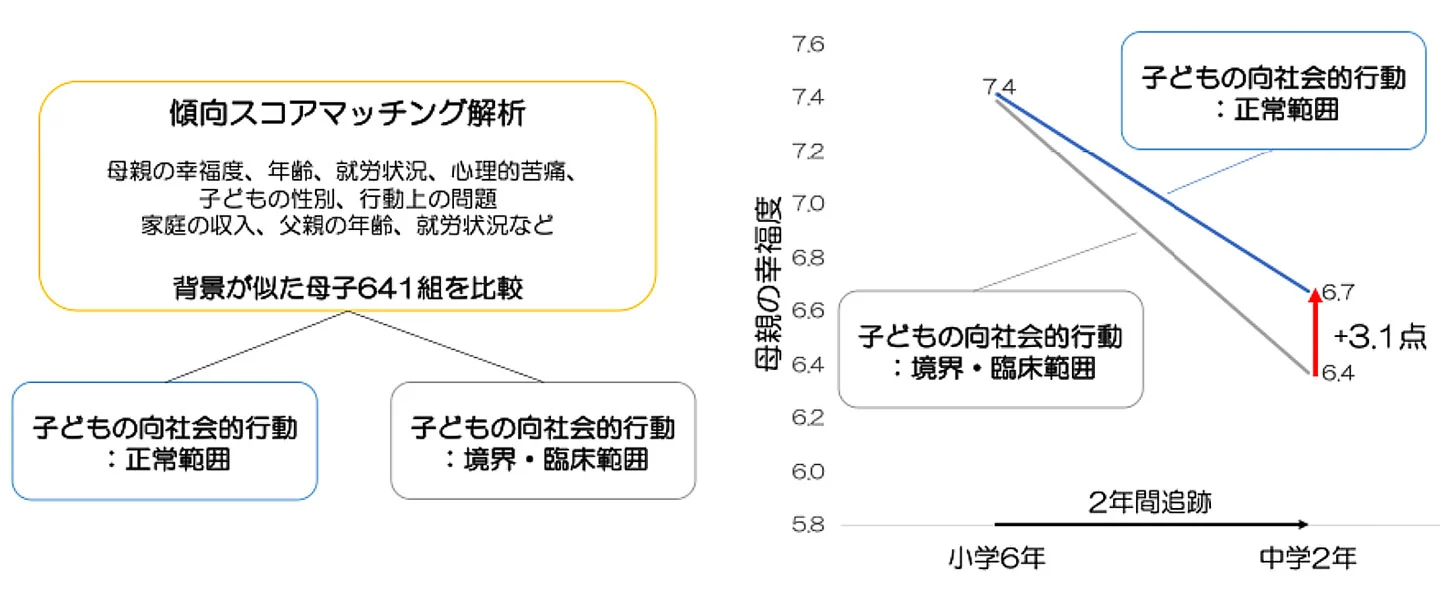
図1. 子どもの向社会的行動と母親の幸福度
<関連情報>
- https://www.isct.ac.jp/ja/news/4xykg1h4tk8u
- https://link.springer.com/article/10.1186/s40359-026-05559-2
青年期の向社会的行動は母親の幸福感と関連しているか?日本における人口ベースの縦断研究の結果 Is adolescent prosocial behavior associated with maternal happiness? Results from a population-based longitudinal study in Japan
Yukako Tani, Aya Isumi & Takeo Fujiwara
BMC Psychology Published:11 September 2026
DOI:https://doi.org/10.1186/s40359-026-05559-2 Early provide
Abstract
Background
The prosocial behaviors of adolescent offspring may be associated with maternal happiness; however, information about the happiness of mothers of adolescents is lacking. The aim of this population-based prospective study was to examine the association between adolescent prosocial behavior and maternal happiness.
Methods
The study used longitudinal data from the Adachi Child Health Impact of Living Difficulty (A-CHILD) study for adolescents in grades 6 (age 12 years) and 8 (age 14 years) and their mothers (n = 2,177). Maternal happiness (0–10) was assessed at both time points. Mothers rated their children’s prosocial behaviors in grade 6 using the Strengths and Difficulties Questionnaire. Adolescents were categorized as having “normal” or “borderline/clinical” prosocial behavior using established cutoff values. Propensity score matching was used to balance baseline demographic, socioeconomic, family, child, and psychosocial characteristics (641 matched pairs).
Results
Maternal happiness was, on average, 1.02 points lower when their children were in grade 8 than in grade 6. In the propensity score-matched analysis, maternal happiness was 0.31 points higher (95% CI, 0.08–0.53) among mothers of children with normal prosocial behavior than among mothers of children with borderline/clinical prosocial behavior.
Conclusions
Although the observed association was modest, children’s prosocial behavior was associated with slightly higher maternal happiness during early to mid-adolescence.