
2026-11-06 中国科学院(CAS)
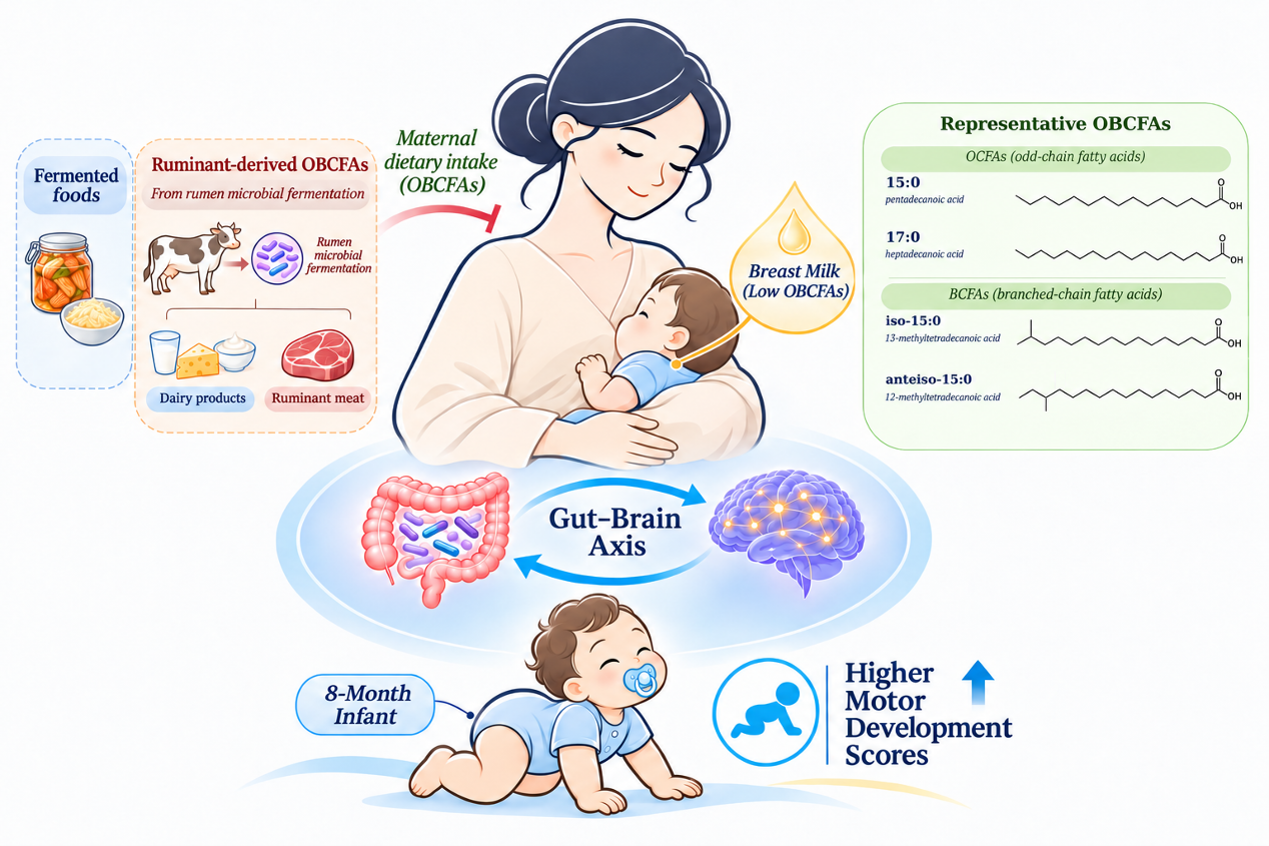
Lower levels of breast milk OBCFAs were associated with better motor development in early infancy.
(Image provided by Prof. GAO Ying’s group)
<関連情報>
- https://english.cas.cn/newsroom/research-news/202611/t20261106_1213515.shtm
- https://link.springer.com/article/10.1007/s00394-026-04152-y
母乳中の奇数鎖および分岐鎖脂肪酸と乳幼児期の神経発達:前向きコホート研究 Odd- and branched-chain fatty acids in breast milk and neurodevelopment in early infancy: a prospective cohort study
Yanrui Bi, Jian Xu, Yao Feng, Lihua Song, Hong Zhou, J. Thomas Brenna, Zhong-Cheng Luo & Ying Gao
European Journal of Nutrition Published:31 October 2026
DOI:https://doi.org/10.1007/s00394-026-04152-y
Abstract
Purpose
Odd-chain and branched-chain fatty acids (OCFAs and BCFAs; OBCFAs) have been linked to human microbiota and may influence neurodevelopment via microbiota-gut-brain axis. However, population-based evidence on OBCFAs and neurodevelopment is sparse.
Methods
A prospective cohort of 120 healthy mother-infant pairs was studied. Breast milk samples were collected at 42 days and 8 months postpartum, with fatty acid profiles quantified using gas chromatography-mass spectrometry. Infant neurodevelopment was assessed at 8 months of age using the Bayley Scales of Infant Development Third Edition, including cognitive and motor developmental quotients (DQs). Associations between OBCFAs and infant DQs were examined by linear regression.
Results
Infants’ motor DQs were inversely associated with breast milk OCFAs levels at 42 days postpartum, including C15:0 (β = −4.27, P = 0.003), C17:0 (β = −4.67, P = 0.001), and total OCFAs (β = −5.07, P < 0.001), as well as total OBCFAs (β = −4.33, P = 0.002). Similar inverse associations were observed for infants’ motor DQs and breast milk OBCFAs at 8 months postpartum (β = −5.37, P = 0.002), including C15:0 (β = −5.31, P = 0.002), C17:0 (β = −5.03, P = 0.004), total OCFAs (β = −5.49, P = 0.001), anteiso-C15:0 (β = −4.92, P = 0.005), and total BCFAs (β = −4.63, P = 0.008); all survived FDR correction (q < 0.05). Stronger inverse associations between OBCFAs and motor DQs were observed among infants born by cesarean delivery, infants with younger mothers (≤ 30y), and infants whose mothers had excessive gestational weight gain.
Conclusions
Lower levels of breast milk OBCFAs were associated with better motor development in early infancy. Further research is needed to confirm and clarify the role of OBCFAs in neurodevelopmental programming.
Clinical trial registration
Chinese Clinical Trial Registry (ChiCTR).

