2026-11-06 カリフォルニア大学リバーサイド校(UCR)
<関連情報>
- https://news.ucr.edu/articles/2026/11/06/why-obesity-affects-males-and-females-differently
- https://academic.oup.com/pnasnexus/article/5/11/pgag365/8995448
脂肪組織好酸球の単一細胞レベルの不均一性は、性別とRELMαによって形成され、肥満におけるマクロファージのコミュニケーションネットワークと関連している Single-cell heterogeneity of adipose eosinophils is shaped by sex and RELMα and linked to macrophage communication networks in obesity
Rebecca E Ruggiero-Ruff , Xinru Qiu , Lauren Vance , Yuxin He , Djurdjica Coss , Adam Godzik , Meera G Nair
PNAS Nexus Published: 24 October 2026
DOI:https://doi.org/10.1093/pnasnexus/pgag365
Abstract
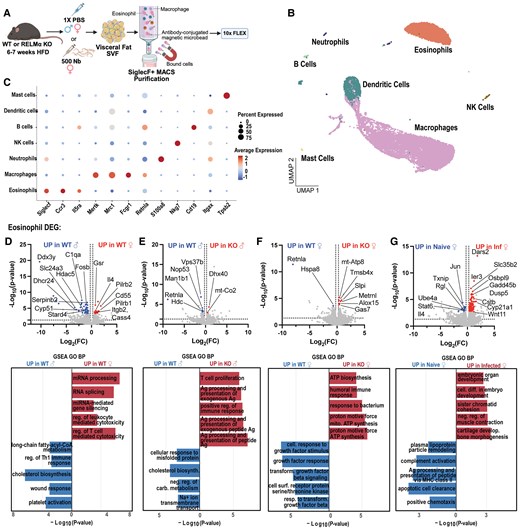
Eosinophils are immune cells with terminal effector functions in type 2 immune responses, yet recent findings suggest that they exhibit functional plasticity and heterogeneity dependent on tissue-specific cues. Building on our prior functional study showing that the immunoregulatory protein RELMα and eosinophils contribute to female protection from high-fat diet (HFD)-induced obesity, we used single-cell transcriptional profiling to study adipose eosinophil states at higher resolution. We identify six transcriptionally distinct eosinophil clusters whose relative abundance differs by sex, helminth infection, and RELMα status. Adipose tissue from females or helminth-infected mice is enriched for eosinophil clusters with type 2/homeostatic-associated transcriptional programs, whereas males and RELMα-deficient mice have increased representation of inflammatory/MHCII-associated clusters together with an altered predicted macrophage–eosinophil communication networks. Spectral flow cytometry and adipose tissue in situ hybridization independently support eosinophil heterogeneity and candidate chemokine-receptor interactions. Through single-cell regulatory network inference and clustering analysis, we further identified transcription factor regulons unique to the specific eosinophil clusters, including sex-differential and HFD-enriched regulatory programs supported by target-gene expression patterns. Collectively, these data provide a framework for describing adipose eosinophil heterogeneity within a previously established RELMα–macrophage–eosinophil axis and identify candidate transcriptional and communication programs for future functional testing.