2026-11-10 国立精神・神経医療研究センター
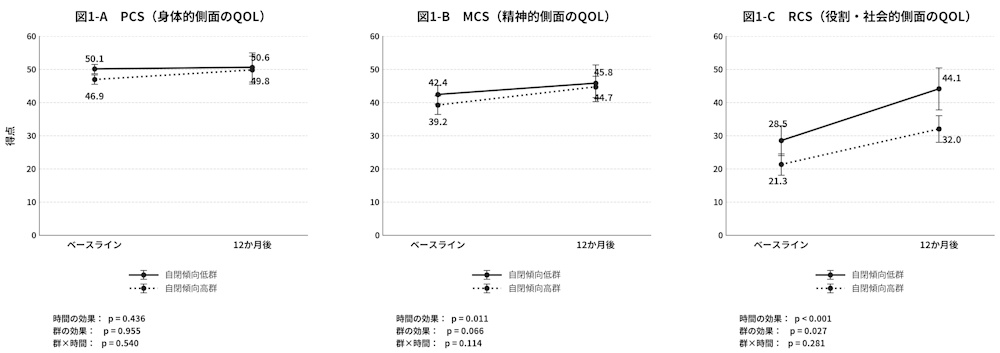
図1 SF-36による健康関連QOL得点の12か月間の変化
点は各群の推定平均値、エラーバーは標準誤差を示す。
<関連情報>
- https://www.ncnp.go.jp/topics/detail.php?@uid=EzSNX9HLgbMeDs3M
- https://www.sciencedirect.com/science/article/abs/pii/S0022395626004462
双極性障害患者における自閉症様特性と健康関連QOLの経時的変化:12ヶ月間の研究 Autistic-like traits and longitudinal changes in health-related quality of life among individuals with bipolar disorder: A 12-month study
Risa Yamada,Hiroshi Kunugi,Takuma Inagawa,Kotaro Hattori,Tomoko Kurashimo,Naoko Ishihara,Haeeun Song,Sawako Sumiyoshi,Sumiko Yoshida,Andrew Stickley,Tomiki Sumiyoshi
Journal of Psychiatric Research Available online: 5 September 2026
DOI:https://doi.org/10.1016/j.jpsychires.2026.09.011
Highlights
- 12-month changes in health-related QOL were followed in 78 patients with bipolar disorder.
- Participants were classified into either elevated- or non-elevated autistic-like trait group.
- Mental QOL improved over time, while physical QOL remained stable in both groups.
- Depressive symptoms improved over time but were consistently higher in the elevated-trait group.
- Autistic-like traits were associated with persistently lower role/social functioning.
Abstract
Objective
Autistic-like traits are common in bipolar disorder (BD) and have been linked to poor functional outcomes, yet their longitudinal impact on quality of life (QOL) remains unclear. This study examined whether autistic-like traits are associated with 12-month changes in health-related QOL in BD.
Methods
Seventy-eight outpatients with BD who completed 12-month follow-up assessments were included (mean age = 34.9 years). Autistic-like traits were assessed using the Social Responsiveness Scale for Adults (SRS-A), with participants classified into elevated- and non-elevated-traits groups. Depressive and manic symptoms were evaluated using the 17-item Hamilton Depression Rating Scale (HAMD-17) and the Young Mania Rating Scale (YMRS). QOL was measured using the 36-Item Short-Form Health Survey (SF-36). Linear mixed models were used to examine longitudinal changes.
Results
HAMD-17 scores demonstrated significant main effects of time and group, reflecting overall improvement but persistently higher depressive symptoms in the elevated-traits group. YMRS scores indicated a significant group effect only. Physical QOL remained stable, while mental QOL improved over time without group differences. Role/social QOL showed significant main effects of time and group, with consistently lower scores in the elevated-traits group. No group × time interactions emerged, suggesting similar rates of change between groups.
Conclusions
This prospective study suggests that autistic-like traits in BD are associated with persistently poorer role/social functioning over time rather than differences in recovery trajectories. Assessing autistic-like traits may help identify patients at risk of poorer functioning and guide tailored psychosocial interventions.