2025-07-09 コペンハーゲン大学(UCPH)
<関連情報>
- https://news.ku.dk/all_news/2025/07/large-scale-dna-study-maps-37000-years-of-disease-history/
- https://www.nature.com/articles/s41586-025-09192-8
古代ユーラシア大陸における人類病原体の時空間分布 The spatiotemporal distribution of human pathogens in ancient Eurasia
Martin Sikora,Elisabetta Canteri,Antonio Fernandez-Guerra,Nikolay Oskolkov,Rasmus Ågren,Lena Hansson,Evan K. Irving-Pease,Barbara Mühlemann,Sofie Holtsmark Nielsen,Gabriele Scorrano,Morten E. Allentoft,Frederik Valeur Seersholm,Hannes Schroeder,Charleen Gaunitz,Jesper Stenderup,Lasse Vinner,Terry C. Jones,Björn Nystedt,Karl-Göran Sjögren,Julian Parkhill,Lars Fugger,Fernando Racimo,Kristian Kristiansen,Astrid K. N. Iversen & Eske Willerslev
Nature Published:09 July 2025
DOI:https://doi.org/10.1038/s41586-025-09192-8
Abstract
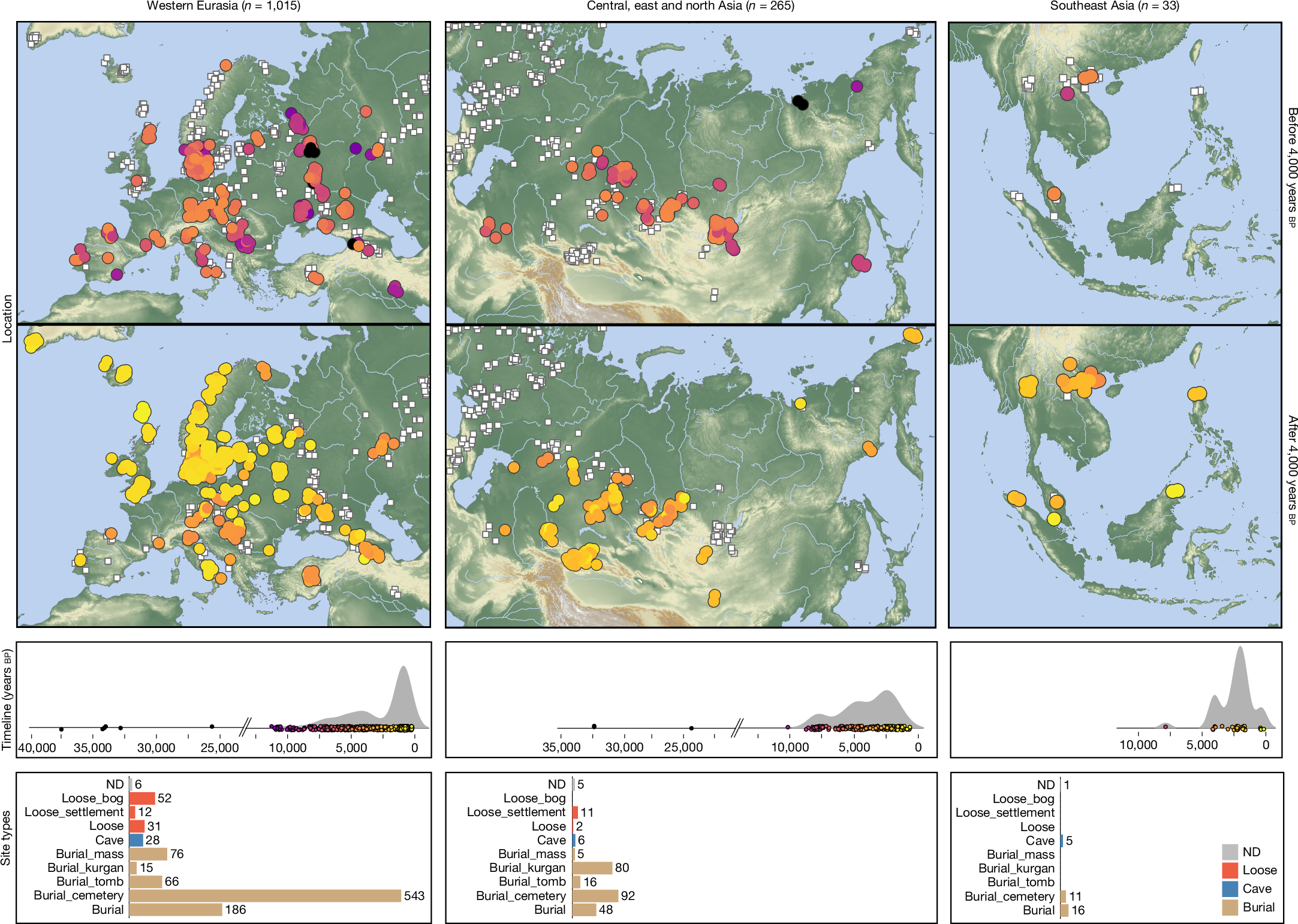
Infectious diseases have had devastating effects on human populations throughout history, but important questions about their origins and past dynamics remain1. To create an archaeogenetic-based spatiotemporal map of human pathogens, we screened shotgun-sequencing data from 1,313 ancient humans covering 37,000 years of Eurasian history. We demonstrate the widespread presence of ancient bacterial, viral and parasite DNA, identifying 5,486 individual hits against 492 species from 136 genera. Among those hits, 3,384 involve known human pathogens2, many of which had not previously been identified in ancient human remains. Grouping the ancient microbial species according to their likely reservoir and type of transmission, we find that most groups are identified throughout the entire sampling period. Zoonotic pathogens are only detected from around 6,500 years ago, peaking roughly 5,000 years ago, coinciding with the widespread domestication of livestock3. Our findings provide direct evidence that this lifestyle change resulted in an increased infectious disease burden. They also indicate that the spread of these pathogens increased substantially during subsequent millennia, coinciding with the pastoralist migrations from the Eurasian Steppe4,5.