2026-05-26 京都大学
京都大学医生物学研究所の河本宏教授らの研究グループは、血液細胞と免疫細胞の進化過程を解析し、約7億年に及ぶ「血液細胞の家系図」を復元した。研究では、多様な動物や単細胞生物の遺伝子発現を比較する新手法を開発し、血液細胞が単細胞生物時代の遺伝子プログラムを基盤として進化してきたことを明らかにした。その結果、最初の血液細胞はマクロファージ様細胞であり、そこからマスト細胞が分岐し、さらにマスト細胞から原始的T細胞や赤血球が、マクロファージから原始的B細胞が派生したことが示された。特に、T細胞とマスト細胞、赤血球、血小板が近縁であるという発見は、免疫細胞進化の理解を大きく更新する成果である。研究グループは、長年提唱してきた「ミエロイド基本型モデル」が進化過程を反映していたことを示す集大成的成果と位置付けている。成果は『PNAS』に掲載され、免疫疾患や血液疾患研究への応用が期待される。
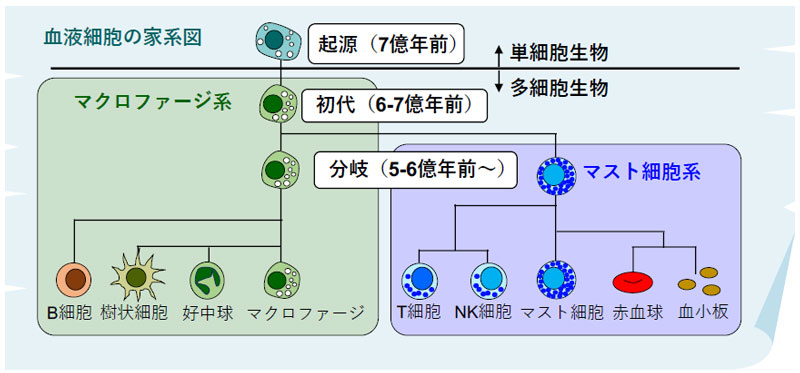
血液細胞の誕生と多様化の歴史。血液細胞の起源は約7億年前、まだヒトの祖先が単細胞生物だった頃まで遡れる。そして、祖先が多細胞生物(動物)として進化した際に、初代の血液細胞としてマクロファージが誕生した。その後の進化の歴史のなかで、マスト細胞などの様々な血液細胞が分岐していった。
<関連情報>
- https://www.kyoto-u.ac.jp/ja/research-news/2026-05-26
- https://www.kyoto-u.ac.jp/sites/default/files/2026-05/web-2605-Kawamoto-24a818eeaea30064d09980748943cb4a.pdf
- https://www.pnas.org/doi/10.1073/pnas.2528110123
動物は単細胞生物時代の祖先のレガシーを血液細胞として拡張させた Animals have expanded the evolutionary legacy of unicellular ancestors in blood cells
Yosuke Nagahata, Yuji Nishimuraa , Ryota Kaitania, Jason Cheok Kuan Leongd, Izumi Oda-Ishiie, Hisanori Kohtsukaf, Shinya Abeg,h, Tasuku Ishidae, Marina Carmona-Rivasb, Sebastian R. Najlei, Elena Casacubertab, Koichi Ikutag, Toru Miuraf, Michio Ogasawaraj, Naoki Iried, Yutaka Satoue, Iñaki Ruiz-Trillob,k, Hiroshi Kawamoto
Proceedings of the National Academy of Sciences Published:May 28, 2026
DOI:https://doi.org/10.1073/pnas.2528110123
Significance
This study provides a transcriptome-based model for the evolutionary history of animal blood cells, from emergence to divergence. The initial blood cells emerged in early animals inheriting unicellular ancestors’ features, followed by the evolution of mast cells in bilaterian ancestors to fight against parasites. Thereafter, in deuterostome/vertebrate ancestors, T/NK cells and erythrocytes/thrombocytes arose from the ancestral mast cells, while B cells evolved from the ancestral macrophages. Along with diversification of blood cell lineages, prototypic thymus formed at the gill edges in chordate ancestors. We finally found a vestige of the evolutionary history in murine hematopoiesis by detecting widely retained macrophage and mast cell potential. These findings shed light on a reciprocal relationship between the evolutionary history and current development pathways.
Abstract
Blood cells are common and unique to animals, enabling them to address critical challenges of defense and transport. Thus, their evolution represents a defining innovation in metazoan multicellular life. However, their evolutionary trajectory about how blood cells emerged and diversified throughout animal history remains unclear. Here, we present a combination of bioinformatics and functional data that demonstrate that the metazoan blood cell program most likely originated through the repurposing of an ancestral premetazoan toolkit governed by Fos. This primordial program established the macrophage-like initial blood cells at the metazoan root. Then, the first lineage bifurcation at the origin of Bilateria drove the emergence of a specialized mast/killer lineage, characterized by acquisition of granular proteases for antiparasitic defense. Subsequent deuterostome/vertebrate innovations branched T/NK and erythrocyte/thrombocyte lineages from mast cells while B cells derived from macrophages. Our data also show that a prototypic thymus formed at the gill edges of a chordate ancestor. In line with the evolutionary history, the modern hematopoietic pathway shows a vestige of the phylogeny; differentiation potentials of phylogenetically old cell lineages expressing Fos such as macrophages and mast cells are widely retained, and ancient HSCs with limited lineage potentials have been inherited as origo-lineage progenitors. Our framework provides the history of blood cells showing an adaptive innovation built upon ancient unicellular foundations.