2025-07-17 国立精神・神経医療研究センター
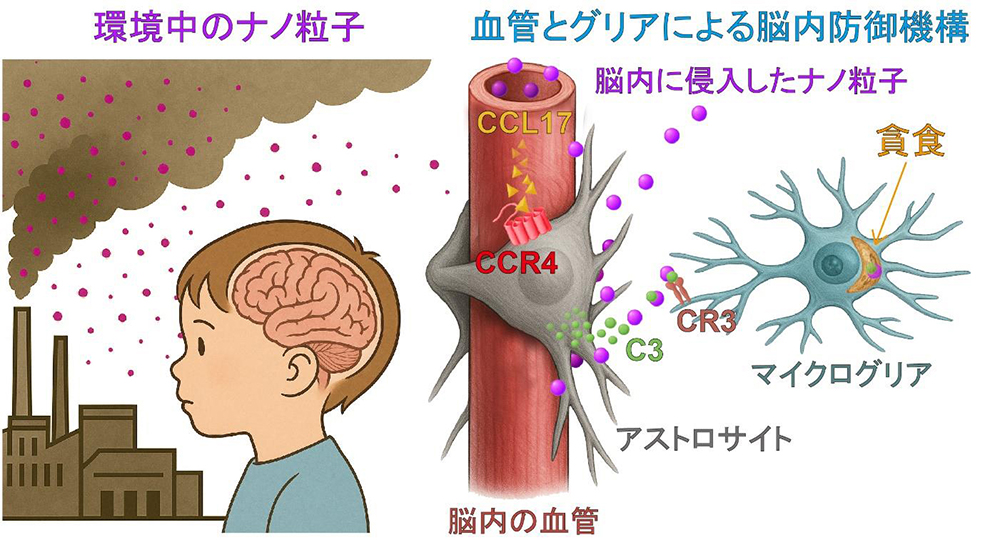
図1:本研究の概要:脳を守る細胞間の連携システムを発見。
<関連情報>
- https://www.ncnp.go.jp/topics/detail.php?@uid=xzrqpf75sGmgIxD2
- https://www.ncnp.go.jp/press_search/images/files/20250716-PR-ncnp.pdf
- https://jneuroinflammation.biomedcentral.com/articles/10.1186/s12974-025-03475-7
グリア-血管ユニットにおけるケモカイン相補カスケードが、非生物学的ナノ粒子からニューロンを保護する Chemokine–complement cascade in glial–vascular units protects neurons from non-biogenic nanoparticles
Ari Ogaki,Shinichi Kinoshita,Yuji Ikegaya & Ryuta Koyama
Journal of Neuroinflammation Published:14 July 2025
DOI:https://doi.org/10.1186/s12974-025-03475-7
Abstract
Non-biogenic nanoparticles (NPs), including silica and polystyrene, are major components of environmental particulate pollution and can accumulate in the brain, especially during development when the blood-brain barrier is immature, leading to neurotoxicity. However, protective responses within the brain to these NPs remain poorly understood. Here, using a developing mouse model, we show that microglia phagocytose non-biogenic NPs through a complement-dependent mechanism involving C3 tagging. This process is regulated by a chemokine cascade in which vascular endothelial cells release CCL17, activating CCR4 on perivascular astrocytes to promote astrocytic C3 production. Inhibition of CCR4 signaling suppresses C3 production, impairs microglial phagocytosis, increases neuronal loss, and exacerbates anxiety-like behaviors. Our data establish a protective role for the vascular–glial chemokine–complement axis in limiting neurotoxicity during brain development. These findings reveal a coordinated immune response to non-biogenic environmental NPs and uncover a vascular–glial mechanism that mitigates NP-induced brain injury.