2025-08-01 東京科学大学
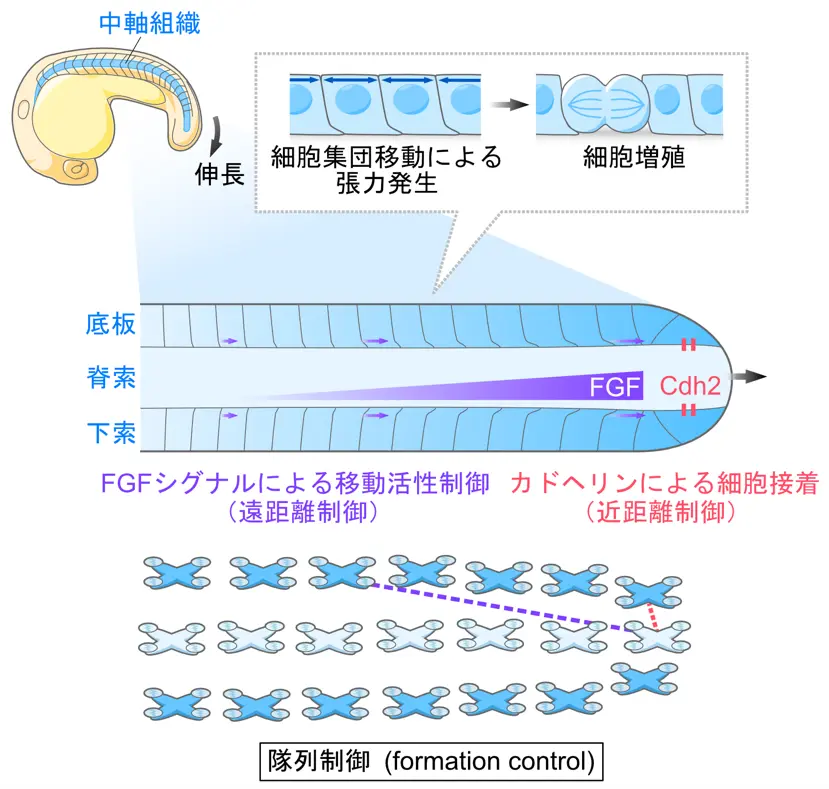 図1. ゼブラフィッシュ胚の中軸組織における、隊列制御による協調的伸長モデル。
<関連情報>
- https://www.isct.ac.jp/ja/news/tt5r85277lwj
- https://www.isct.ac.jp/plugins/cms/component_download_file.php?type=2&pageId=&contentsId=1&contentsDataId=2065&prevId=&key=b60634cf0e16b554775e8d563c3920dd.pdf
- https://www.science.org/doi/10.1126/sciadv.ads2310
リーダー組織と移動性追従組織間の形成制御は協調的な成長を可能にする Formation control between leader and migratory follower tissues allows coordinated growth
Toru Kawanishi, Takamichi Sushida, Tony Y.-C. Tsai, Hiroyuki Takeda, and Sean G. Megason
Science Advances Published:30 Jul 2025
DOI:https://doi.org/10.1126/sciadv.ads2310
Abstract
Coordinated growth of multiple tissues is fundamental to shaping our body, but the underlying mechanisms remain underexplored. In zebrafish embryos, midline tissues composed of the notochord, floorplate, and hypochord elongate synchronously with their lengths aligned. We show that floorplate and hypochord cells collectively migrate posteriorly along the nascent notochord extracellular matrix as it extends posteriorly, maintaining the tripartite configuration. Fibroblast growth factor-mediated migration in a spatially graded manner causes cell stretching, which triggers Yap-dependent proliferation and controls floorplate and hypochord growth. Supported by mathematical modeling, we further suggest that their growth is fine-tuned by mechanical tethering to the notochord via cadherin 2 at the posterior end. We propose that the notochord instructs and sustains the tripartite formation via leader-follower formation control, a strategy from engineering that spatially organizes multiple agents to coordinate the growth of the midline tissues.