2025-08-05 大阪大学
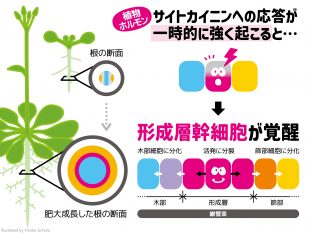
図 1 本研究のイメージ図
幹細胞の覚醒が植物の肥大成長をもたらす
<関連情報>
- https://www.sci.osaka-u.ac.jp/ja/topics/15647/
- https://www.sci.osaka-u.ac.jp/ja/wp-content/uploads/2025/07/PR_Kondo.pdf
- https://www.nature.com/articles/s41477-025-02051-4
サイトカイニン反応の最大値は、放射状成長のための両面幹細胞を誘導し活性化する A cytokinin response maximum induces and activates bifacial stem cells for radial growth
Shunji Shimadzu,Takaaki Yonekura,Tomoyuki Furuya,Mikiko Kojima,Kimitsune Ishizaki,Masashi Asahina,Kyoko Ohashi-Ito,Hitoshi Sakakibara,Hidehiro Fukaki,Hiroo Fukuda & Yuki Kondo
Nature Plants Published:04 August 2025
DOI:https://doi.org/10.1038/s41477-025-02051-4
Abstract
Wood is formed as plants expand in thickness through radial growth, which initiates after apical growth. At the onset of radial growth, dormant procambial cells in the vasculature become active and act as bifacial cambium stem cells, which produce xylem (wood) inward and phloem outward. Cytokinin has been implicated in radial growth initiation; however, its precise mechanisms, especially at the cellular level, remain unclear. Here we show a switching mechanism of radial growth, in which a cytokinin response maximum (CRM) transiently appearing in roots beyond the meristem induces stem cell activation. Manipulation of the CRM revealed that procambial cells primarily retain phloem differentiation competence but newly acquire xylem differentiation and self-renewal capabilities upon experiencing the CRM. Transcriptome analysis and mathematical modelling showed that the CRM is driven by cytokinin production and subsequent positive and negative signalling feedback loops. Our findings therefore demonstrate that a dynamic hormone response establishes multipotent stem cells de novo by providing proper competences to undifferentiated cells arising from the meristematic tissue, enabling the post-embryonic growth transition. This mechanism may serve as the basis for the vitality of plants, which continue to grow vigorously even after embryogenesis.