2025-08-06 国立環境研究所,北海道大学
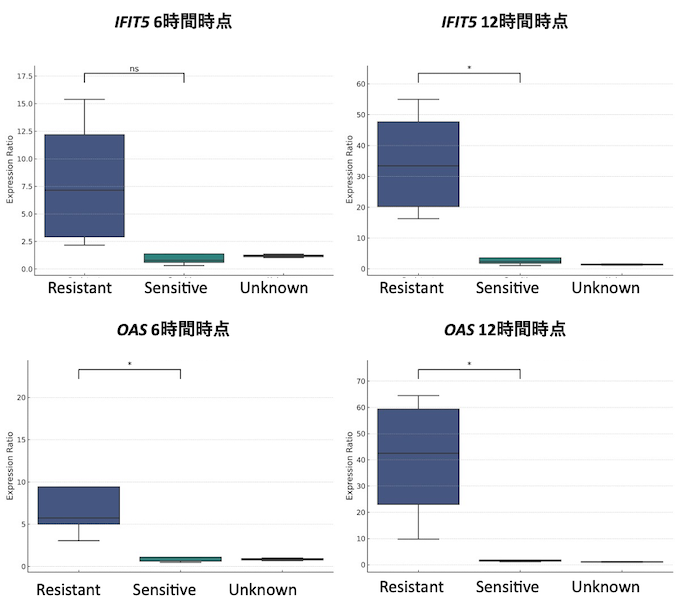
図:IFIT5遺伝子とOAS遺伝子の抵抗性(Resistant)、感受性(Sensitive)、感受性不明(Unknown)鳥類種間での発現量変化
抵抗性鳥類においてIFIT5遺伝子が鳥インフルエンザウイルス感染後12時間時点で、OAS遺伝子では6、12時間時点で遺伝子の発現量が大きく増加していることがわかる
<関連情報>
- https://www.nies.go.jp/whatsnew/2025/20250806/20250806.html
- https://www.nature.com/articles/s41598-025-01316-4
野生鳥類における高病原性鳥インフルエンザへの耐性に関連する新規ホスト因子の同定(一次細胞培養からの推論) Novel host factors associated with resistance to highly pathogenic avian influenza in wild birds inferred from primary cell culture
Kei Nabeshima,Shingo Asakura,Yoshihiro Sakoda & Manabu Onuma
Scientific Reports Published:29 May 2025
DOI:https://doi.org/10.1038/s41598-025-01316-4
Abstract
Bird species differ in the sensitivity to the highly pathogenic avian influenza virus (HPAIV). Here, we infected fibroblasts from 11 bird species with the H5N1 HPAIV strain A/chicken/Yamaguchi/7/2004. These species were categorized into three groups based on previous studies: HPAI-resistant (rock pigeon, hooded crane, white-necked crane, and Japanese crane), HPAI- susceptible (chicken, mountain hawk-eagle, northern goshawk, peregrine falcon, and golden eagle), and those with unknown susceptibility to HPAI (Okinawa rail and Japanese white stork). We performed gene expression analysis to identify genes uniquely upregulated in the HPAI-resistant species and determine genetic markers of HPAIV susceptibility. We found that two genes involved in antiviral response: OAS and IFIT5 expression levels were commonly upregulated after infection in the HPAI-resistant species, but not in the HPAI- susceptible species or species with unknown sensitivity to HPAI. In addition, upregulation ratios of OAS expression at 6 h post-infection and of OAS and IFIT5 at 12 h post-infection were significantly higher in the resistant species than in the susceptible species. We conclude that IFIT5 and OAS could be genetic markers for HPAIV susceptibility, and that Okinawa rail and Japanese white stork are likely susceptible to HPAIV, indicating the need for their conservation and protection against HPAIV infection.