2025-08-12 中国科学院(CAS)
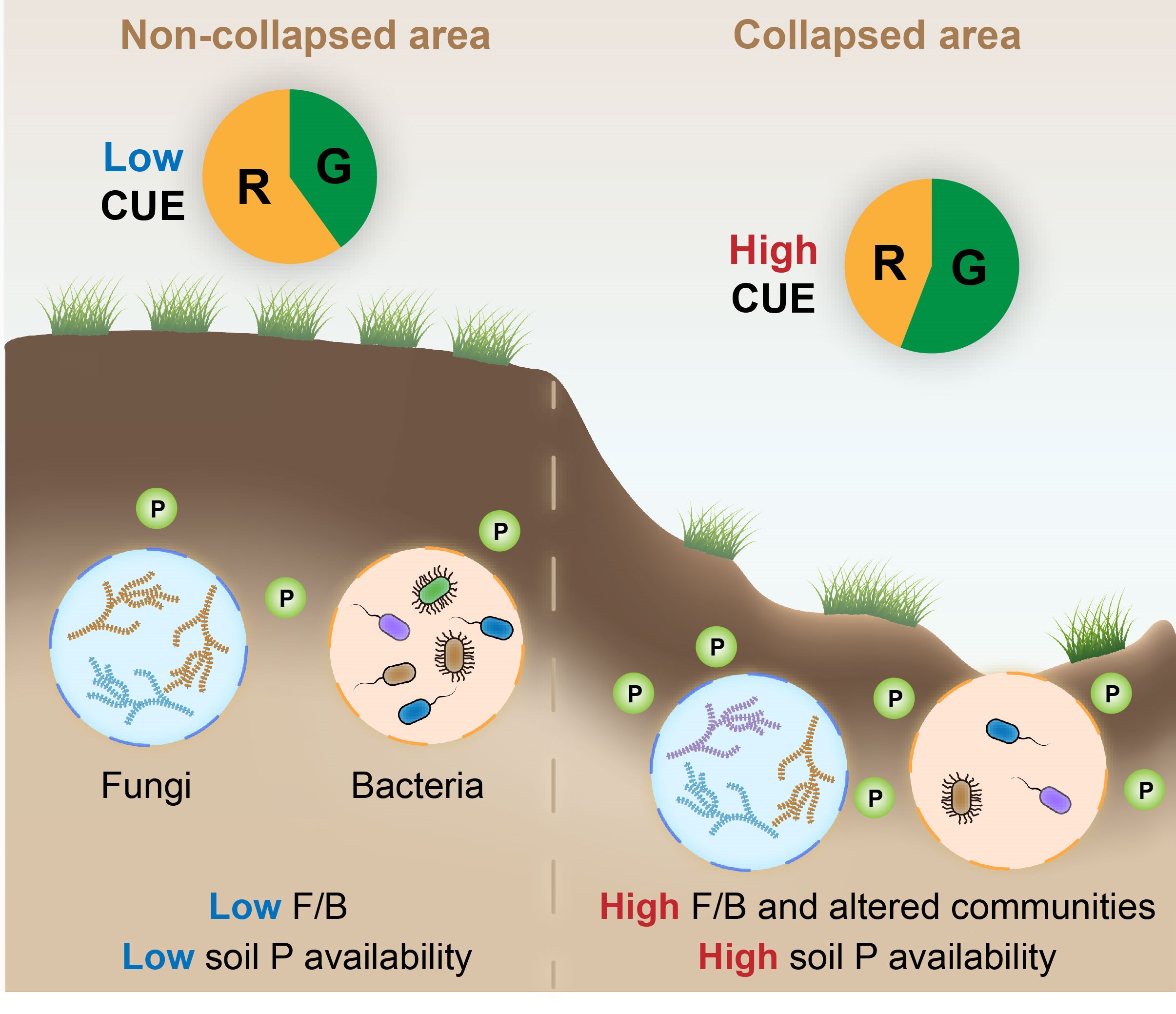 Increased microbial carbon use efficiency driven by altered microbial community composition and improved soil phosphorus availability. (Image by QIN Shuqi)
<関連情報>
- https://english.cas.cn/newsroom/research_news/life/202508/t20250818_1050903.shtml
- https://www.pnas.org/doi/10.1073/pnas.2419206122
永久凍土の急激な融解に伴う微生物の炭素利用効率の向上 Increased microbial carbon use efficiency upon abrupt permafrost thaw
Shuqi Qin, Guanqin Wang, Dianye Zhang, and Yuanhe Yang
Proceedings of the National Academy of Sciences Published:August 12, 2025
DOI:https://doi.org/10.1073/pnas.2419206122
Significance
Microbial carbon use efficiency (CUE) describes the ratio of carbon (C) retained in biomass over C uptake. Despite its importance in determining soil C loss and formation, how microbial CUE would change upon permafrost thaw remains poorly understood. We find that topsoil (0 to 10 cm) microorganisms grow faster and own higher CUE after abrupt permafrost thaw. The accelerated growth is primarily due to the changes in microbial community composition (larger biomass of fungi relative to bacteria and more fast-growing taxa) and the increased soil phosphorus availability. These findings suggest that the elevated microbial CUE after permafrost thaw would potentially promote the incorporation of microbial cellular components into soil and consequently stimulate the formation of stable soil C.
Abstract
Soil carbon (C) dynamics upon permafrost thaw represents a major uncertainty in climate projections. Both soil C loss and formation in permafrost regions are mediated by microorganisms, and the balance of these two processes could be characterized by a synthetic metric termed microbial carbon use efficiency (CUE, defined as the ratio of C used for growth over C uptake). However, how microbial CUE responds to permafrost thaw remains unclear due to the lack of direct experimental evidence. Here, based on an ~27 y permafrost thaw sequence and five additional thermokarst-impacted sites across the northeastern Tibetan Plateau, we investigate the response of microbial CUE to abrupt permafrost thaw using a substrate-independent 18O tracing approach. Results from the thaw sequence and additional sites at the regional scale consistently reveal that topsoil (0 to 10 cm) microbial CUE increases after permafrost collapse as a consequence of accelerated growth. The elevated microbial growth and CUE are driven by the alterations in microbial communities with larger ratio of fungal to bacterial biomass and more copiotrophs. In addition, the increased soil phosphorus availability could also promote microbial growth and CUE. These results highlight that the higher microbial CUE upon abrupt permafrost thaw would potentially enhance soil C stability by promoting the deposition of microbial-derived C into soil. Earth system models should thus explicitly characterize microbial CUE and its drivers to accurately predict permafrost C-climate feedback.