2025-08-25 福井大学
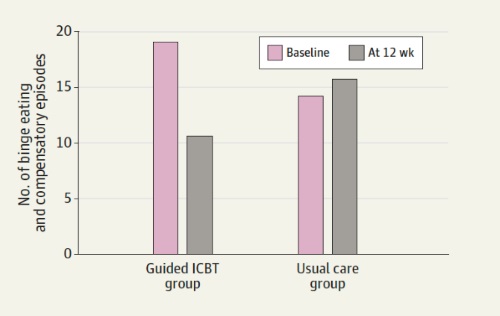
図1:過食および代償行動エピソード数の12週間後の変化
治療者誘導型オンライン認知行動療法群(Guided ICBT group、左)では、治療前と比べて12週後に過食・代償行動の合計頻度が約10回減少し、重症度の有意な改善が認められた。通常治療群(Usual care group、右)では明確な変化は見られなかった。
<関連情報>
- https://www.u-fukui.ac.jp/result/108506/
- https://www.u-fukui.ac.jp/wp/wp-content/uploads/press-release_hamatani.pdf
- https://jamanetwork.com/journals/jamanetworkopen/fullarticle/2837260
神経性過食症の女性に対するガイド付きインターネット認知行動療法:ランダム化比較試験 Guided Internet-Based Cognitive Behavior Therapy for Women With Bulimia Nervosa A Randomized Clinical Trial
Sayo Hamatani, PhD; Kazuki Matsumoto, PhD; Gerhard Andersson, PhD:et al
JAMA Network Open Published:August 5, 2025
DOI:10.1001/jamanetworkopen.2025.25165
Key Points
Question Is guided internet-based cognitive behavior therapy (ICBT) effective in the treatment of women with bulimia nervosa in an outpatient psychiatric setting?
Findings In this randomized clinical trial of 61 women with bulimia nervosa, women who received ICBT plus usual care had a significant decrease in bulimia symptoms compared with women who received usual care only.
Meaning These findings support guided ICBT as a promising intervention for women with bulimia nervosa receiving treatment in psychiatric settings.
Abstract
Importance Despite the rising prevalence of bulimia nervosa and the associated risks of chronicity and severe physical and psychological morbidity, access to effective treatment remains poor. The effectiveness and acceptability of internet-based cognitive behavior therapy (ICBT) for women with bulimia nervosa in clinical settings in East Asia remain unclear.
Objective To determine the effectiveness and acceptability of a guided ICBT program to treat women with bulimia nervosa in Japan.
Design, Setting, and Participants This randomized clinical trial was conducted at 7 university hospitals in Japan between August 2022 and October 2024. This study enrolled female participants aged 13 to 65 years whose symptoms met the Diagnostic and Statistical Manual of Mental Disorders (Fifth Edition) criteria for bulimia nervosa, had a body mass index (BMI) of 17.5 or greater, had internet access, and had no history of practicing CBT-related techniques within the past 2 years.
Interventions Both the control and intervention groups received usual care. The intervention consisted of ICBT with additional guidance from a therapist. The therapy program was tailored to Japanese culture and grounded in a specific cognitive behavior model, and it was performed over a 12-week period.
Main Outcomes and Measures Severity of bulimia nervosa, measured by the weekly combined frequency of episodes involving binge eating and compensatory behaviors, was assessed by a blinded, independent rating team at baseline and at the 12-week intervention end point. Intention-to-treat analyses were conducted using a linear mixed model with effect sizes calculated using Cohen d.
Results A total of 61 women met the eligibility criteria and were randomized to the intervention group (n = 31) or the control group (n = 30). Participants were predominantly young (mean [SD] age, 27.8 [9.0] years), had normal weight (mean [SD] BMI, 21.1 [3.6]), and had a mean (SD) duration of illness of 9.3 (8.8) years; half (31 [50.8%]) were employed. Intent-to-treat analysis revealed that guided ICBT significantly reduced the weekly combined frequency of episodes involving binge eating and compensatory behaviors (by an adjusted mean difference of 9.84 episodes [95% CI, 2.49-17.18 episodes], P = .01; Cohen d = 0.73 [95% CI, 0.21-1.26]). Sensitivity analyses supported these findings.
Conclusions and Relevance In this randomized clinical trial, the intervention group experienced a significant decrease in bulimia symptoms compared with the control group, supporting the effectiveness and acceptability of the therapist-guided ICBT program. These findings suggest that integration of therapist-guided ICBT in usual care has the potential to improve accessibility to efficacious treatment options for women with bulimia nervosa.
Trial Registration UMIN Clinical Trials Registry Identifier: UMIN00048732