2025-08-26 高知大学
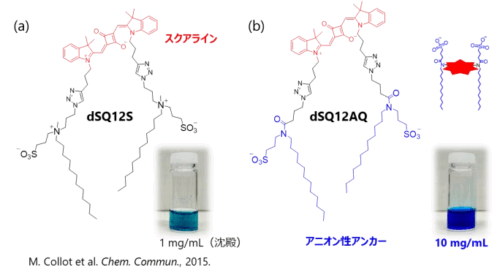
図 1. (a) 既存の細胞膜プローブ dSQ12S および (b) 本研究にて開発した dSQ12AQ の化学構造
<関連情報>
- https://www.kochi-u.ac.jp/information/2025082100019/
- https://www.kochi-u.ac.jp/wp-content/uploads/2025/08/file_20258262105037_1.pdf
- https://pubs.rsc.org/en/content/articlehtml/2025/sc/d5sc03047a
明るく水分散性の膜プローブが、生きたマウスの光散乱組織における細胞形態と動態の可視化を可能にする Bright and water-dispersible membrane probes enable visualization of cellular morphologies and dynamics in light-scattering tissues of living mice
Takumi Uemura, Ryosuke Kawakami, Hitomi Seki, Satoshi Yoshida, Masamoto Murakami, Takeshi Imamura, Hadano Shingo, Shigeru Watanabe and Yosuke Niko
Chemical Science Published:20th June 2025
DOI:https://doi.org/10.1039/D5SC03047A
Abstract
Fluorescent plasma membrane probes are indispensable tools for biological studies, enabling the visualization of the fine structure and dynamics of plasma membranes, and, by extension, the overall morphology of living cells. However, their use has been mostly limited to imaging cultured cells or fixed tissue slices. Indeed, few probes have been optimized for visualizing cellular morphologies in intact tissues or organs. Here, we report a new bright squaraine-based membrane probe, dSQ12AQ, which incorporates two anionic anchor groups (sulfonate and long alkyl chain) to ensure high water dispersibility without precipitation—even at concentrations exceeding 10 mg mL-1. This highly concentrated probe solution was intravenously administered to living mice without the need for dimethyl solfoxide or other solubilizing agents. Combined with two-photon microscopy, dSQ12AQ enabled clear visualization of whole-cell morphology in vivo, allowing dynamic imaging of flowing, rolling, and/or remaining stationary blood cells in the bone marrow vasculature. Moreover, dSQ12AQ extravasated from blood vessels, enabling further staining and visualization of cells in the perivascular bone marrow region. This extravasation was also observed in the hind paw skin, enabling clear visualization of keratinocytes in the epidermis, as well as fibroblasts and eccrine sweat duct cells in the dermis. These results highlight the potential of dSQ12AQ as a valuable tool for in vivo studies of various cellular processes and for investigation of refractory or poorly understood diseases and their treatments.