2025-11-08 東京大学
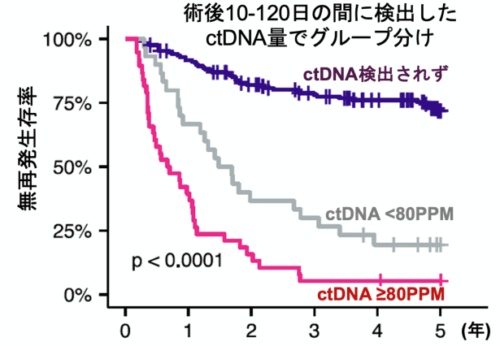
図 1:術後の無再発生存率
ctDNA が検出されなかった患者と比較し、ctDNA が検出された症例はいずれも高い割合で再発を認めた。
<関連情報>
- https://www.h.u-tokyo.ac.jp/press/20251108.html
- https://www.h.u-tokyo.ac.jp/press/__icsFiles/afieldfile/2025/11/07/release_20251108.pdf
- https://www.cell.com/cell/fulltext/S0092-8674(25)01192-4
高解像度の肺がんリスク予測のための縦断的超高感度ctDNAモニタリング Longitudinal ultrasensitive ctDNA monitoring for high-resolution lung cancer risk prediction
James R.M. Black ∙ Takahiro Karasaki ∙ Charles W. Abbott ∙ … ∙ Sean M. Boyle ∙ Richard O. Chen ∙ Charles Swanton
Cell Published:November 7, 2025
DOI:https://doi.org/10.1016/j.cell.2025.10.020
Highlights
- Ultrasensitive ctDNA detection identifies a distinct intermediate risk group in NSCLC
- ctDNA kinetics show clinical utility for adjuvant therapy and disease monitoring
- Postoperative ctDNA kinetics predict the timing, risk, and anatomical patterns of relapse
- A refined ctDNA detection-guided schema is proposed for improving NSCLC management
Summary
Biomarkers accurately informing prognostic assessment and therapeutic strategy are critical for improving patient outcome in oncology. Here, we apply a whole-genome, tumor-informed circulating tumor DNA (ctDNA) detection approach to address this challenge, leveraging 1,800 variants across 2,994 plasma samples from 431 patients with non-small cell lung cancer (NSCLC) from the TRACERx study. We show that ultrasensitive ctDNA detection below 80 parts per million both pre- and postoperatively is highly prognostic, and combinatorial analysis of the pre- and postoperative ctDNA status identifies an intermediate risk group, improving disease stratification. ctDNA kinetics demonstrate clinical utility during adjuvant therapy, where patients that “clear” ctDNA during adjuvant therapy experience improved outcomes. Moreover, characterization of patterns in postoperative ctDNA kinetics reveals insights into the timing, risk, and anatomical pattern of relapses. By incorporating longitudinal ultrasensitive ctDNA detection, we propose a refined schema for guiding the stratification and treatment recommendations in early stage NSCLC.