2025-11-12 カリフォルニア大学リバーサイド校 (UCR)
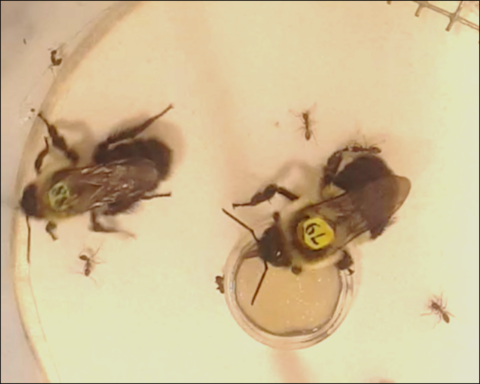
Bumble bees on a feeder in the lab surrounded by Argentine ants. (Michelle Miner/UCR)
<関連情報>
- https://news.ucr.edu/articles/2025/11/12/when-ants-battle-bumble-bees-nobody-wins
- https://academic.oup.com/jinsectscience/article/25/6/ieaf076/8317081
ミツバチはアリの直接的な攻撃に応じて蜜採集行動を調整する(膜翅目:ミツバチ科とアリ科) Bees modulate behavior during nectar foraging in response to direct ant aggression (Hymenoptera: Apidae and Formicidae)
Michelle Constanza Miner, Erin E Wilson Rankin
Journal of Insect Science Published:07 November 2025
DOI:https://doi.org/10.1093/jisesa/ieaf076
Abstract
Nectar thieves may seriously impact pollinator foraging behavior and, ultimately, pollination services in natural and agricultural contexts. Despite strong interest in pollinators and their services, there remain gaps in our knowledge as to how ants influence bee foraging decisions. Here, we characterized ant–bee interactions at shared resources and the subsequent behavioral sequences exhibited by bees. We found that two-thirds of bumble bee (Bombus impatiens Cresson) behaviors at nectar resources involved direct interactions with Argentine ants (Linepithema humile Mayr). Consistent with predictions of interference competition, the number of ants at a shared resource decreased the probability of a bee feeding and increased the likelihood of a bee being bitten. Similarly, getting bitten by an ant decreased the probability that a bee would subsequently feed and increased the likelihood that a bee engaged in aggressive responses, such as gaping mandibles and attacking the ant. Behavioral sequences fell into two clusters: Cluster 1 was characterized by feeding and nonaggressive behaviors, and Cluster 2 was exemplified by strings of aggressive behaviors. Behavioral sequences that included aggression were longer and more diverse than those involving predominately nonaggressive behaviors, demonstrating that aggression (either on the part of the bee or the ant) extended behavioral exchanges and disrupted bumblebee foraging and resource collection. Our study identified that ant abundance and aggressive biting behaviors were strong predictors of subsequent bee actions. Such experiences may contribute to learned avoidance of ants in future encounters, consistent with interference competition theory, and have broader implications for disrupted foraging in social animals.