2025-11-17 スイス連邦工科大学ローザンヌ校(EPFL)
<関連情報>
- https://actu.epfl.ch/news/brain-stimulation-improves-vision-recovery-after-s/
- https://academic.oup.com/brain/advance-article/doi/10.1093/brain/awaf252/8322719?login=false
半盲の回復を促進する:両脳領域間クロス周波数刺激の力 Boosting hemianopia recovery: the power of interareal cross-frequency brain stimulation
Estelle Raffin, Michele Bevilacqua, Fabienne Windel, Pauline Menoud, Roberto F Salamanca-Giron, Sarah Feroldi, Sarah B Zandvliet, Nicola Ramdass, Laurijn Draaisma, Patrik Vuilleumier …
Brain Published:17 November 2025
DOI:https://doi.org/10.1093/brain/awaf252
Abstract
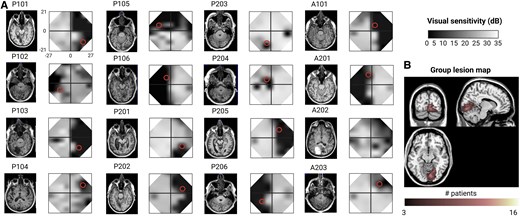
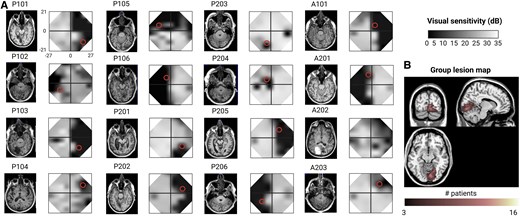
Visual field loss is a common consequence of stroke and manifests in approximatively one-third of patients in the chronic stage. Such loss can significantly impact daily life activities, compromising tasks such as reading, navigating or driving. Although slow and labour intensive, evidence suggests that early interventions with tailored rehabilitation programmes might stimulate visual recovery and improve quality of life in stroke survivors.
To enhance the effects of such rehabilitation programmes, we designed a novel, non-invasive, pathway-specific, physiology-inspired cross-frequency brain stimulation protocol, where complex oscillatory signal integration was inferred from phase–amplitude coupling of oscillatory signals between the primary visual cortex and the motion-sensitive medio-temporal area. Sixteen stroke patients were enrolled in a double-blind, randomized, cross-over trial, during which they performed two blocks of 10 daily training sessions of a direction discrimination task, combined with one of the two cross-frequency transcranial alternative brain stimulation (cf-tACS versus control cf-tACS) conditions.
We found that the cf-tACS condition promoting feedforward visual inputs to the medio-temporal area significantly enhanced motion discrimination performance and shifted visual field borders (i.e. through localized enlargement of isopters). Behavioural improvements associated with a change in oscillatory activity within motion processing pathways were proportional to the amount of residual structural fibres along these pathways and perilesional primary visual cortex activity. In sum, we report, for the first time, that cf-tACS, a novel, pathway-specific, physiology-inspired brain stimulation approach, is able to boost the efficacy of perceptual training, restoring visual motion processing and reducing the severity of visual impairments in adult stroke patients.