2026-04-20 英国研究イノベーション機構(UKRI)
<関連情報>
- https://www.ukri.org/news/gut-microbiome-changes-may-signal-parkinsons-disease-risk/
- https://www.nature.com/articles/s41591-026-04318-5
健康な人および遺伝的にリスクのある人におけるパーキンソン病のマイクロバイオームの特徴
Microbiome signature of Parkinson’s disease in healthy and genetically at-risk individualsElisa Menozzi,Yani Ren,Mallia Geiger,Jane Macnaughtan,Micol Avenali,Marco Toffoli,Marine Gilles,Rosaria Calabrese,Pierfrancesco Mitrotti,Luca Gallo,Alexandre Famechon,Sara Lucas Del Pozo,Roxana Mezabrovschi,Sofia Koletsi,Nadine Loefflad,Selen Yalkic,Naomi Limbachiya,Frederick Clasen,Suleyman Yildirim,Saeed Shoaie,Hervé Blottière,Christian Morabito,Aymeric David,Benoit Quinquis,… Anthony H. V. Schapira
Nature Medicine Published:20 April 2026
DOI:https://doi.org/10.1038/s41591-026-04318-5
Abstract
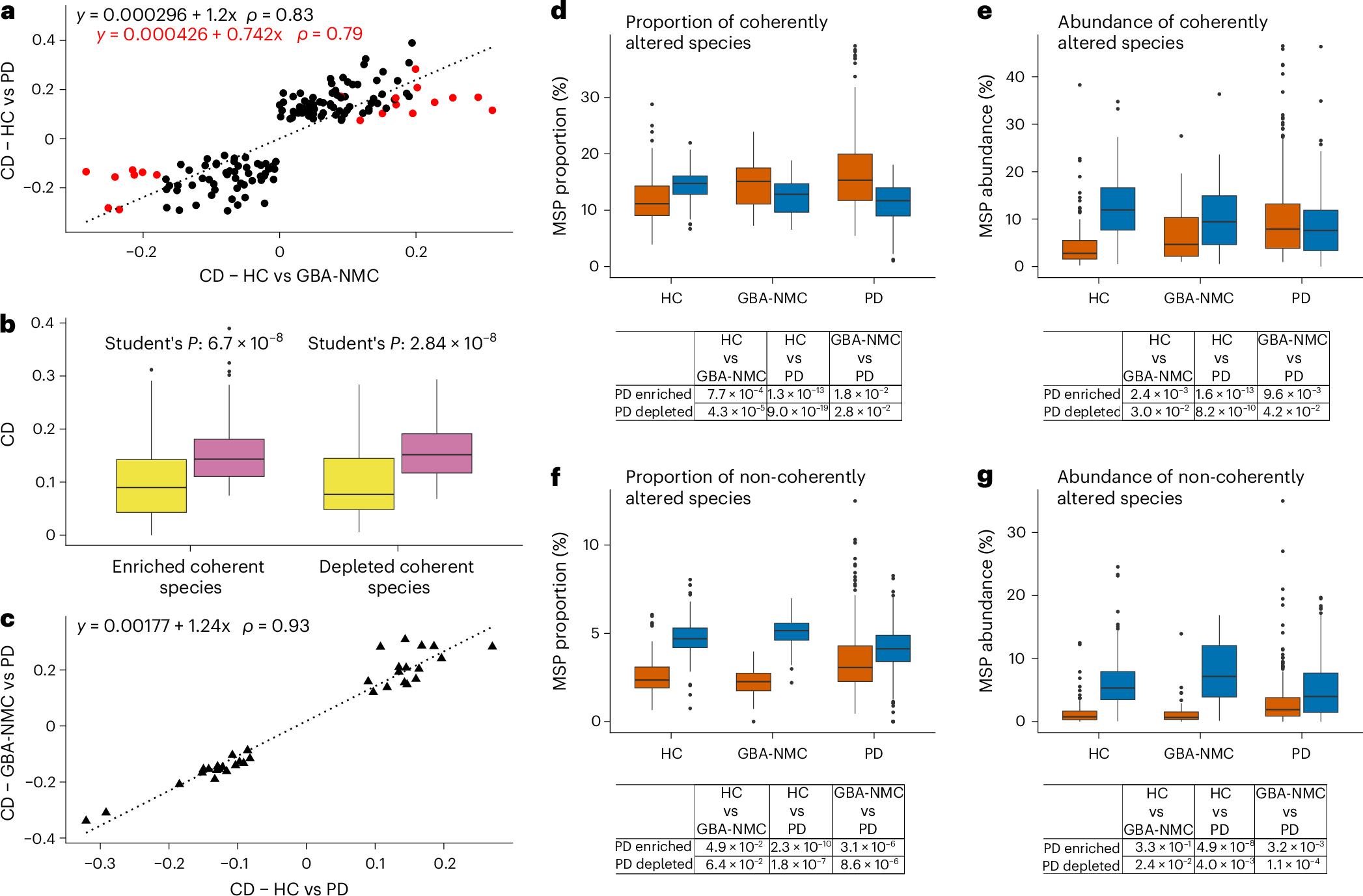
Parkinson’s disease (PD) is a major cause of disability. GBA1 variants are the most common genetic risk factor for PD and increase the risk up to 30-fold. Why only approximately 20% of GBA1 variant carriers develop PD remains unknown. Here, by combining clinical and fecal metagenomics data from 271 patients with PD, from 43 carriers of GBA1 variants not manifesting PD symptoms (GBA-NMC) and from 150 healthy controls, and using an innovative microbiome analysis, combining differential abundance of species and coherence of differential abundance variation between the groups as assessed by Cliff’s delta (δ), we show that the composition of a large component of the gut microbiome (approximately 25%) in GBA-NMC is intermediate between healthy controls and patients with PD. This component is strongly correlated with disease progression in patients and prodromal symptoms suggestive of future development of PD in both GBA-NMC and healthy individuals. We found microbiome alterations similar to those described here in three independent cohorts from the United States, Korea and Turkey, totaling 638 patients with PD and 319 healthy controls, and we conclude that gut microbiome alterations can identify both genetically and non-genetically at-risk individuals in the general population who may be progressing toward PD, thus serving as an early marker of disease development in the premanifest phase.