
2026-05-28 ノースカロライナ州立大学(NC State)
<関連情報>
- https://news.ncsu.edu/2026/05/ammonia-levels-in-urine-could-serve-as-marker-for-chronic-kidney-disease-in-dogs/
- https://academic.oup.com/jvim/article/40/3/aalag100/8697385
安定した慢性腎臓病の犬におけるアンモニア排泄障害と生存率との関連性 Association of impaired ammonia excretion with survival in dogs with stable chronic kidney disease
Autumn N Harris,Alexis Cooper,Rebeca A Castro,Andrew J Specht,Shelly L Vaden,Kirsten L Cooke
Journal of Veterinary Internal Medicine Published:28 May 2026
DOI:https://doi.org/10.1093/jvimsj/aalag100
Abstract
Background
In people with chronic kidney disease (CKD), inadequate renal ammonia excretion contributes to metabolic acidosis and is associated with worse outcomes. However, the prognostic relevance of ammonia excretion in dogs with CKD remains unclear.
Hypothesis/Objectives
A reduced urine ammonia-to-creatinine ratio (UACR) would be associated with shorter survival and faster disease progression in dogs with stable CKD.
Animals
Fifty client-owned dogs with International Renal Interest Society (IRIS) stages II-IV CKD receiving a therapeutic renal diet.
Methods
Prospective, observational longitudinal study. Dogs were followed for up to 12 months or until death. Progressive CKD was defined as a > 25% increase in serum creatinine from baseline. Dogs were categorized based on UACR < 2.0 or ≥ 2.0. Associations with survival and CKD progression were assessed using Cox proportional hazards and Kaplan–Meier analyses.
Results
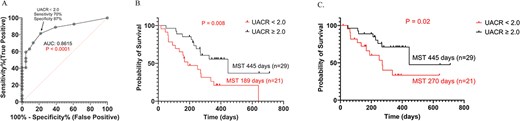
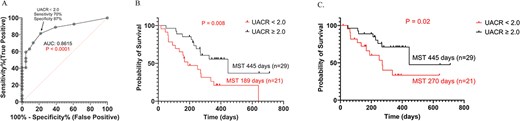
Most dogs were IRIS stage II (41/50, 82%). Dogs with UACR < 2.0 at enrollment had a significantly greater risk of death (HR 3.045; 95% CI, 1.372-7.102) and shorter median survival (189 vs 445 days, P = .008). Dogs with UACR < 2.0 also had a significantly shorter time to CKD progression (median 132 vs 445 days; P = .0002). In addition, UPC ratio < 1.0 was associated with a lower risk of death (HR 0.351; 95% CI, 0.142-0.879).
Conclusions and clinical importance
Lower UACR (<2.0) was associated with higher case fatality and faster disease progression in dogs with azotemic CKD. Urine ammonia-to-creatinine ratio might be a useful biomarker for identifying dogs which could benefit from alkali therapy.

