2026-01-15 中国科学院(CAS)
<関連情報>
- https://english.cas.cn/newsroom/research-news/202602/t20260210_1150336.shtml
- https://www.nature.com/articles/s41422-025-01202-8
線維層常在Angptl7+骨膜幹細胞は損傷炎症を感知し骨折修復を調整する Fibrous-layer resident Angptl7+ periosteal stem cells sense injury inflammation to orchestrate fracture repair
Bo Jiang,Wenhui Xing,Xiaocui Xu,Shuqin Chen,Heng Feng,Rui Shao,Jiatong Sun,Yazhuo Zhang,Zaiqi Xie,Wenxiang Wang,Xubin Yin,Yi Wang,Miaomiao Wang,Ling Li,Zhong Zhang,Bo Gao,Jinlong Suo,Xuye Hu,Lijun Wang,Jun Sun,Bin Zhou,Bo O. Zhou,Matthew B. Greenblatt,Rongrong Le & Weiguo Zou
Cell Research Published:08 January 2026
DOI:https://doi.org/10.1038/s41422-025-01202-8
Abstract
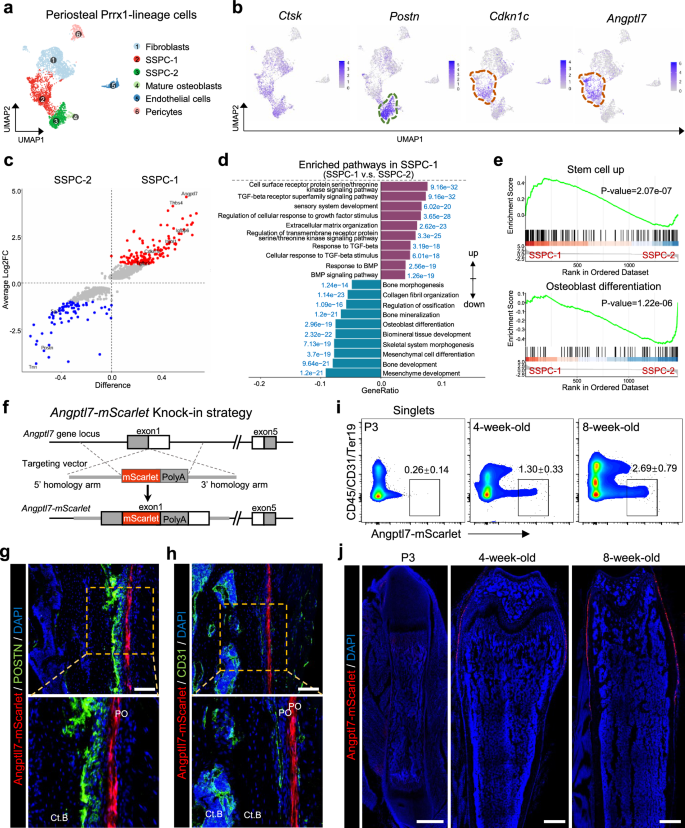
Periosteum contains abundant Ctsk-lineage skeletal stem cells (P-SSCs) that are key drivers of intramembranous ossification during bone development and maintenance. However, P-SSCs regenerate fractured bones by mediating endochondral ossification, raising the question of whether distinct P-SSCs subsets separately mediate steady-state bone formation and fracture repair. Here we uncover the heterogeneity of P-SSCs, identifying an Angptl7-expressing quiescent P-SSCs subset, which is restricted to the fibrous-layer of periosteum and barely contributes to postnatal bone development. After bone fracture, these cells largely contribute to bone healing by dedicating to endochondral ossification, regenerating the entire bone architecture. Dysfunction of Angptl7-lineage P-SSCs strongly impairs the bone healing process but does not affect steady-state bone formation. Multimodal analysis reveals that these cells can be immediately activated under the regulation of TNF-α/NF-κB signaling, subsequently acquiring osteogenic capacity. Together, our findings unravel an injury-specified P-SSCs subpopulation, providing a model that there are tissue-resident stem cells specialized for injury repair, while parallel stem cells maintain homeostasis.