2026-01-22 国立精神・神経医療研究センター ,東京都医学総合研究所 ,東京大学
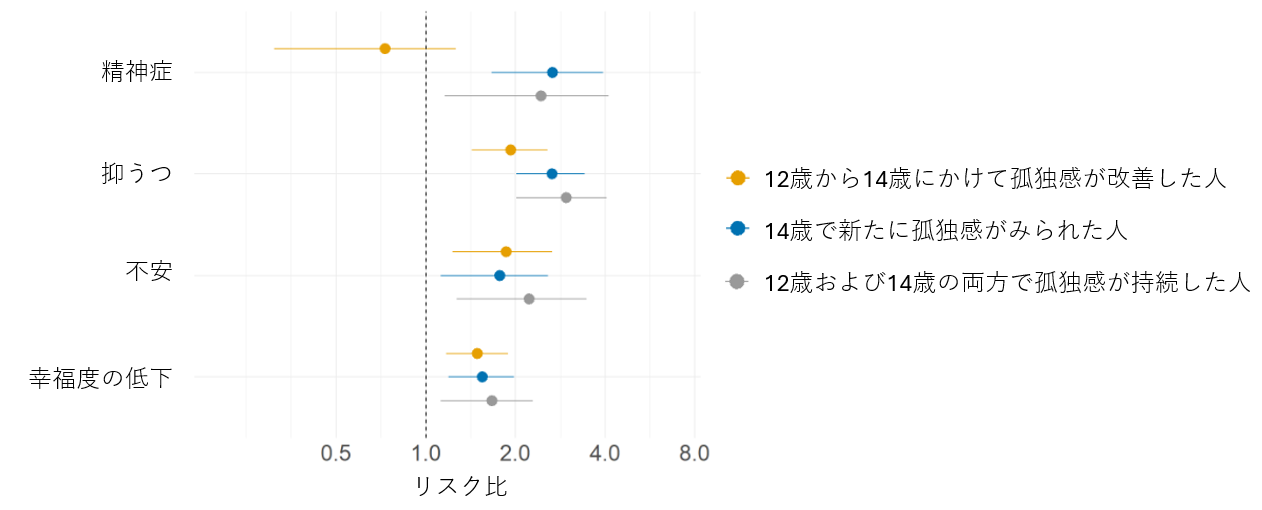
図1. 孤独感の経時的パターンとメンタルヘルス不調リスクの関連
孤独感が改善した人は、孤独感が持続した人に比べて、リスクが軽減される。
<関連情報>
- https://www.ncnp.go.jp/topics/detail.php?@uid=VEwHV5nszH79Xr01
- https://www.ncnp.go.jp/press_search/images/files/PressRelease/20260122pressrelease.pdf
- https://acamh.onlinelibrary.wiley.com/doi/10.1111/jcpp.70114
思春期における孤独感の経時的パターンと、その後の精神症・抑うつ・不安・幸福度低下との関連 Loneliness patterns across time and subsequent risk of psychotic experiences, depression, anxiety, and diminished well-being in adolescents
Zui C. Narita, Jordan DeVylder, Gemma Knowles, Syudo Yamasaki, Mitsuhiro Miyashita, Daniel Stanyon, Satoshi Yamaguchi, Tomohiro Shinozaki, Ryo Sasaki, Rui Zhou, Shuntaro Ando, …
Journal of Child Psychology and Psychiatry Published: 22 January 2026
DOI:https://doi.org/10.1111/jcpp.70114
Abstract
Background
Evidence on the association between loneliness and psychotic experiences in adolescents remains limited. Moreover, loneliness has typically been assessed at a single time point, which fails to capture its dynamic nature. We hypothesized that persistent loneliness, assessed across repeated measures, would be associated with psychotic experiences and other mental health problems.
Methods
Using longitudinal data from 3,171 participants in the Tokyo Teen Cohort, we applied the g-formula. We analyzed how loneliness patterns at ages 12 and 14 were associated with psychotic experiences, depression, anxiety, and diminished well-being at age 16, accounting for time-fixed and time-varying confounders. Missing data were handled using multiple imputation by chained equations.
Results
Persistent loneliness was associated with increased risk and greater severity of psychotic experiences (RD 7.1%, 95% CI: 0.8–14.3; RR 2.44, 95% CI: 1.16–4.11; β 0.28, 95% CI: 0.10–0.48). Incident loneliness at age 14 showed similar associations. No association was found for adolescents whose loneliness had remitted by age 14 (RD -1.3%, 95% CI: -3.6 to 1.2; RR 0.73, 95% CI: 0.31–1.26; β 0.01, 95% CI: -0.04 to 0.08). Sensitivity analyses using marginal structural models yielded results that were largely unchanged. Findings were generally similar for other mental health problems. Associations were consistent across genders, although the association with well-being appeared particularly important for girls.
Conclusions
The dynamics of loneliness are associated with a wide range of mental health problems in adolescents. The risk may not be permanent and could be mitigated if loneliness remits. Further research examining interventions that target loneliness is warranted.