2026-02-04 ワシントン州立大学(WSU)
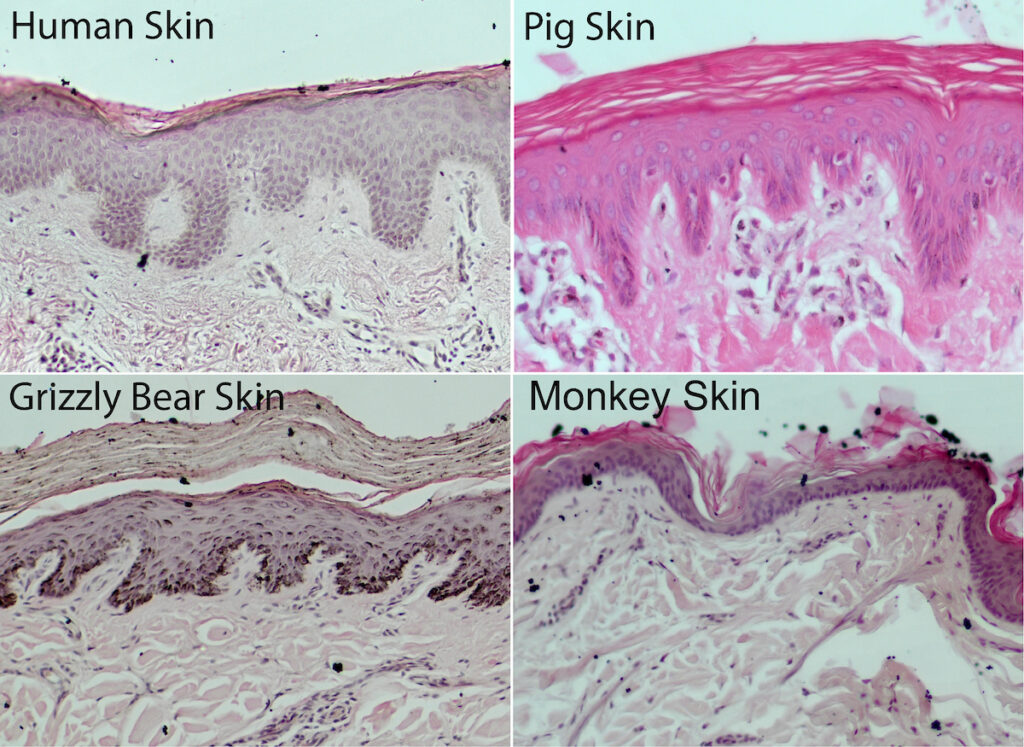
These microscopic views of layers of skin shows how humans, grizzly bears, and pigs (but not monkeys) all share valley-like skin microstructures called rete ridges, which are visible in the bottom sections of these slide images (photos by Ryan Driskell and Sean Thompson, College of Veterinary Medicine).
<関連情報>
- https://news.wsu.edu/press-release/2026/02/04/pigs-and-grizzlies-not-monkeys-hold-clues-to-youthful-human-skin/
- https://www.nature.com/articles/s41586-025-10055-5
哺乳類の皮膚において、進化的に異なるメカニズムによって網状隆起が形成される Rete ridges form via evolutionarily distinct mechanisms in mammalian skin
Sean M. Thompson,Violet S. Yaple,Gabriella H. Searle,Quan M. Phan,Jasson Makkar,Xiangzheng Cheng,Ruiqi Liu,Anna Pulawska-Czub,Corin Yanke,Natalie M. Williams,Isabelle V. Busch,Tommy T. Duong,Matteo V. Corneto,Zachary S. Jordan,Debarun Roy,Adam B. Salmon,Ov D. Slayden,Brian P. Hermann,David A. Stoltz,Michael J. Welsh,UW Birth Defects Research Laboratory,Ian A. Glass,Krzysztof Kobielak,Qing Nie,… Ryan R. Driskell
Nature Published:04 February 2026
DOI:https://doi.org/10.1038/s41586-025-10055-5
Abstract
The loss of fur during human evolution has long mystified scientists and the public1,2,3,4,5. Reduced hair density coincides with acquisition of epidermal rete ridges, the developmental timing and molecular mechanisms of which are poorly understood despite their prominence in humans1,6,7,8,9. Examination of human and pig skin development has shown that rete ridges form through a mechanism independent from those of hair follicles10,11 and sweat glands3,4,12,13,14,15 by establishing interconnected epidermal invaginations. Here we document the occurrence of rete ridges across Mammalia, including in grizzly bears and dolphins, and show that neonatal pig wounds can regenerate them de novo. Multispecies spatiotemporal transcriptomics identifies significant signalling interactions between epidermal and dermal cells during rete ridge morphogenesis, particularly through bone morphogenetic proteins (BMP). We also demonstrate that mouse fingerpad skin forms rete ridges and functionally requires epidermal BMP signalling. We propose that evolution of rete ridges in mammalian skin involved replacement of the molecular program for formation of discrete microscopic appendages, including hair follicles and sweat glands, with a distinct program for the interconnected appendage network. Broad epidermal activation of BMP is required for the development of rete ridge networks organized around underlying dermal pockets. Understanding rete ridge mechanisms may enable development of therapeutic approaches to regenerate epidermal appendages lost during wounding or disease in humans.