2026-03-19 チャルマース工科大学
<関連情報>
- https://news.cision.com/chalmers/r/direct-nervous-system-link-promises-more-natural-leg-prostheses,c4320547
- https://www.nature.com/articles/s41467-026-69297-0
神経内記録から幻肢運動を解読する Decoding phantom limb movements from intraneural recordings
Cecilia Rossi,Marko Bumbasirevic,Paul Čvančara,Thomas Stieglitz,Stanisa Raspopovic,Elisa Donati & Giacomo Valle
Nature Communications Published:08 February 2026
DOI:https://doi.org/10.1038/s41467-026-69297-0
Abstract
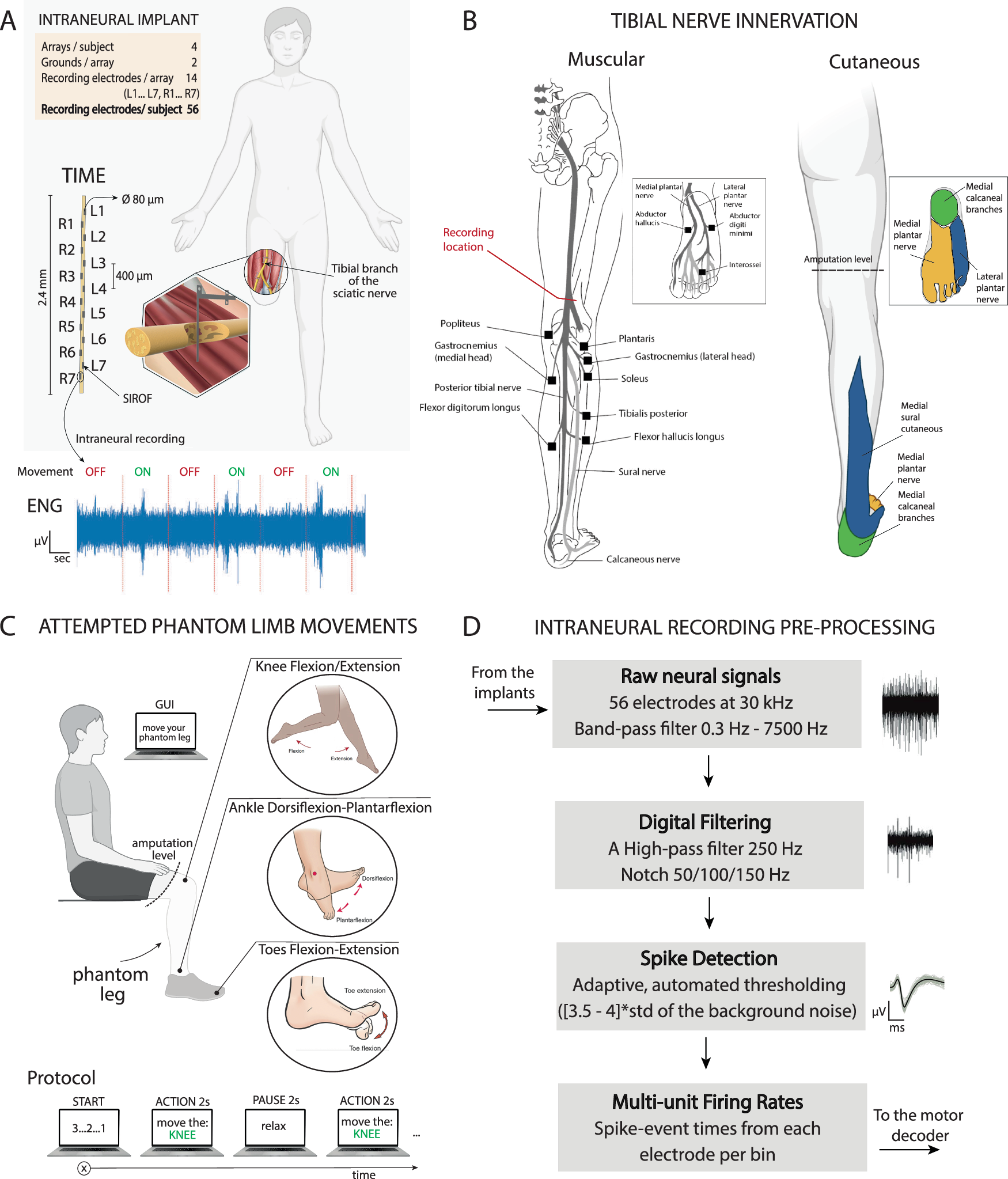
Limb loss causes severe sensorimotor deficits and often necessitates prosthetic devices, particularly in lower-limb amputees. Although direct neural recording from residual nerves offers a biomimetic route for prosthetic control, low signal amplitudes and challenges in nerve interfacing have limited adoption. Intraneural multichannel electrodes provide a potential solution by enabling access to motor signals from muscles lost after amputation. Here, we report intraneural recordings from two transfemoral amputees using transversal intrafascicular multichannel electrodes implanted in distal branches of the sciatic nerve. We identified multiunit activity associated with volitional phantom movements of the knee, ankle, and toes, exhibiting joint- and direction-specific modulation distributed across electrodes. A Spiking Neural Network–based decoder outperformed conventional methods in predicting attempted movements, with further gains achieved by integrating intraneural and intermuscular signals. Motor and sensory maps showed minimal overlap, indicating early segregation within the sciatic nerve. These findings pave the way for bidirectional, neurally-controlled prosthetic systems.
00014-3/asset/7c28d956-1671-464a-91be-d2306431fafe/main.assets/gr1_lrg.jpg "糖尿病薬オゼンピックが精神健康改善と関連(Diabetes drug Ozempic linked to better mental health)")