2026-03-27 国立精神・神経医療研究センター,奈良県立医科大学
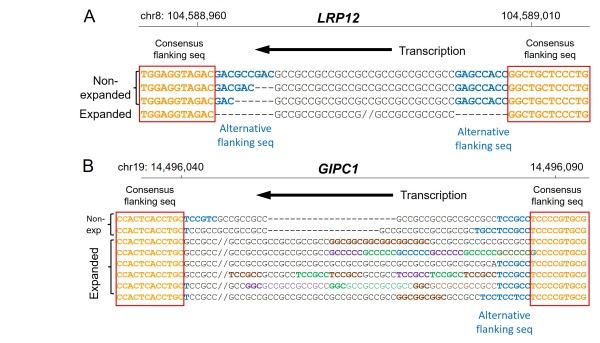
【図1】疾患リピート伸長DNA鎖における近傍配列、リピート配列の相違
<関連情報>
- https://www.ncnp.go.jp/topics/detail.php?@uid=yK2zZ7x3YArMxmbr
- https://link.springer.com/article/10.1186/s13073-026-01617-x
眼咽頭遠位筋症における病原性CGGリピート伸長は、隣接配列上の各原因遺伝子の明確な特徴とメチル化状態を示す Pathogenic CGG expansions in oculopharyngodistal myopathy exhibit distinct characteristics of each causative gene on the flanking sequences as well as methylation status
Nobuyuki Eura,Satoru Noguchi,Megumu Ogawa,Kyuto Sonehara,Ai Yamanaka,Takashi Kurashige,Shinichiro Hayashi,Yukinori Okada,Kazuma Sugie & Ichizo Nishino
Genome Medicine Published:27 March 2026
DOI:https://doi.org/10.1186/s13073-026-01617-x
Abstract
Background
Oculopharyngodistal myopathy (OPDM) is a hereditary muscle disease caused by CGG/CCG repeat expansions in six genes. Although the clinical features are often similar, such as ptosis, dysphagia, and distal muscle weakness, the age at onset vary widely, and the mechanisms underlying this variation remain unclear. In particular, the contributions of repeat size, flanking sequence variation, and DNA methylation to phenotype have not been systematically explored using single-molecule resolution.
Methods
We applied CRISPR/Cas9-targeted nanopore sequencing (nCATS) to genomic DNA from 91 individuals carrying expanded CGG repeats in three OPDM-related genes (LRP12, GIPC1, and NOTCH2NLC). This approach enabled the simultaneous analysis of CGG repeat length, flanking sequence architecture, single nucleotide variant haplotypes, structural variation, and CpG methylation profiles. Genotype–phenotype correlations were evaluated by integrating molecular and clinical data.
Results
Expanded LRP12 and GIPC1 alleles in the patients showed respective single nucleotide variant patterns around repeat regions, suggesting founder haplotypes. Repeat regions essentially comprised pure CGG expansions, but exhibited size variability, even within patients. Additionally, LRP12-expanded repeats lacked flanking nucleotide sequences present in non-expanded repeats, whereas GIPC1 expanded repeats contained specific discontinued CGG patterns in their 5′-regions. Structural variations were also identified in some patients. A significant inverse correlation was observed between repeat length and age at onset in patients with GIPC1 or NOTCH2NLC expansions, while this was disturbed by higher methylation of upstream regions in patients with LRP12 expansions, leading to delayed onset.
Conclusions
This study highlights gene-specific differences in CGG repeat architecture and epigenetic regulation in OPDM. Founder haplotypes, expanded allele-specific flanking sequences, and the combined effects of repeat size and methylation contribute to patient regional frequency, repeat stability, and clinical variability, respectively, offering insight into disease pathomechanism and potential therapeutic targets.