2026-03-20 ロックフェラー大学
米ロックフェラー大学の研究により、アリが仲間と外敵を識別する仕組みが解明された。アリは体表の化学物質(カットキュラ炭化水素)を手がかりに個体識別を行い、触角で相手を検査することでコロニーの仲間かどうかを判断する。本研究では、神経系がこの化学シグナルのわずかな違いを高精度に識別し、攻撃行動や受容行動を切り替える仕組みを明らかにした。
この成果は、社会性昆虫における集団行動やコミュニケーションの理解を深めるとともに、嗅覚情報処理や神経回路の研究にも重要な知見を提供する。
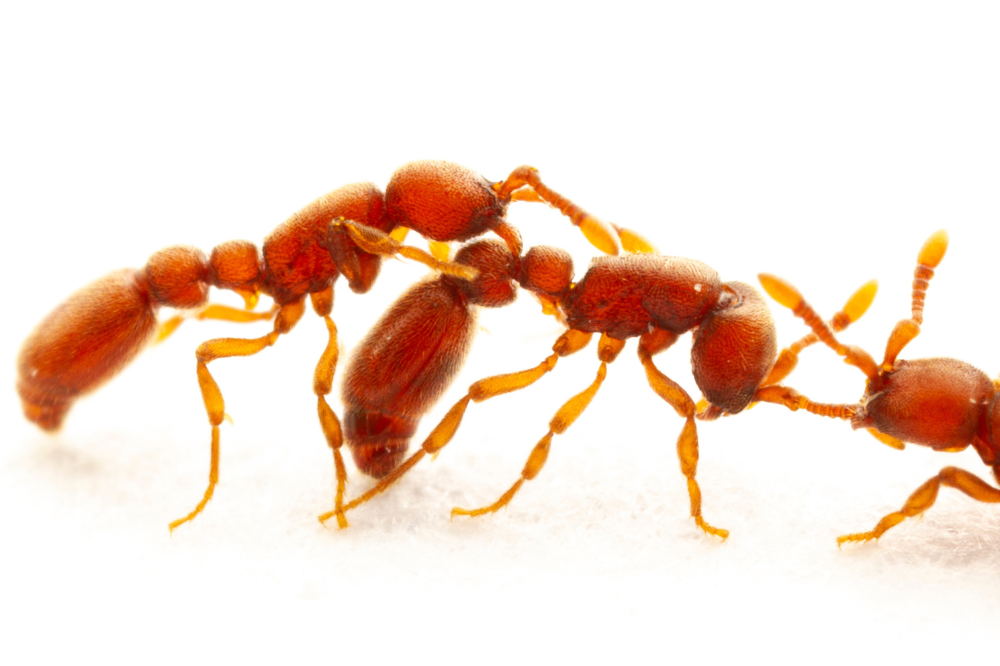
Intruder ant being attacked by ants from a colony. (Credit: Daniel Kronauer)
<関連情報>
- https://www.rockefeller.edu/news/39218-how-ants-distinguish-friend-from-foe/
- https://www.cell.com/current-biology/fulltext/S0960-9822(26)00228-9
アリにおける外来種への耐性獲得には慢性的な曝露が必要だが、維持には散発的な曝露で十分である Tolerance toward foreigners in ants requires chronic exposure for establishment but only sporadic exposure for maintenance
Tiphaine P.M. Bailly ∙ Matteo Rossi ∙ Stephany Valdés-Rodríguez ∙ Thomas Schmitt ∙ Erik T. Frank ∙ Daniel J.C. Kronauer
Current Biology Published:March 20, 2026
DOI:https://doi.org/10.1016/j.cub.2026.02.041
Highlights
- Ants aggress foreign genotypes, but extended exposure induces tolerance
- Although aggression returns after separation, sporadic re-exposure maintains tolerance
- Social tolerance is shaped by experience-dependent plasticity
Summary
Social insects discriminate between foreigners and members of their own colony via complex olfactory cues. Although it is known that genetically distinct individuals can sometimes be accepted as nestmates, the conditions that facilitate the acquisition, maintenance, and loss of tolerance, as well as the timescales of these processes, remain incompletely understood. Here, we address this gap by studying non-nestmate discrimination in the clonal raider ant, Ooceraea biroi, which provides unparalleled experimental control over the genotype of individuals and the genotypic composition of colonies. Using a cross-fostering design with mixed-genotype colonies of wild-type and transgenically labeled individuals, we show that ants become non-aggressive specifically toward their foster genotype. This tolerance is transient, and aggression resumes after 2 weeks of being isolated from the foster colony. However, even sporadic re-exposure to individuals from the foster colony is sufficient to maintain tolerance for over a month, while the same paradigm fails to establish tolerance in the first place. This shows that non-nestmate discrimination is remarkably plastic and that, once established, tolerance toward foreigners can be maintained by only intermittent contact. These dynamics echo general principles of social learning and contact-dependent tolerance described in other social species, including humans.