2026-04-07 ジョージア大学(UGA)
<関連情報>
- https://news.uga.edu/bird-flu-and-environment/
- https://onlinelibrary.wiley.com/doi/10.1111/ele.70265
水鳥は、多様な環境や人間が居住する地域では移動性が低く、鳥インフルエンザウイルスの拡散に影響を与える可能性がある Waterfowl Move Less in Heterogeneous and Human-Populated Landscapes, With Implications for Spread of Avian Influenza Viruses
Claire S. Teitelbaum, Diann J. Prosser, Joshua T. Ackerman, Sakib Ahmed, A. B. M. Sarowar Alam, Kazi Zenifar Azmiri, Nyambaya Batbayar, Joël Bêty, Abigail Blake-Bradshaw
Ecology Letters Published: 23 January 2026
DOI:https://doi.org/10.1111/ele.70265
ABSTRACT
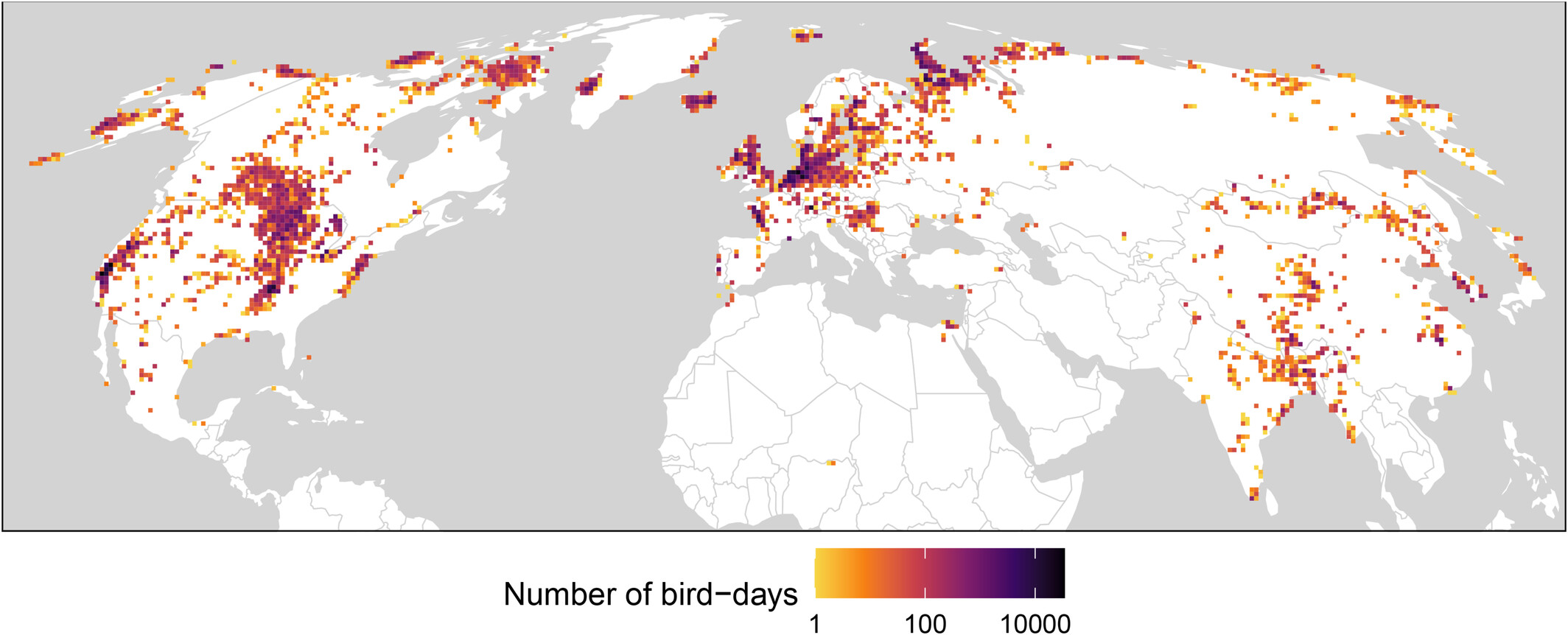
Animal movements contribute to the spread of infectious diseases and are driven in part by environmental conditions. We investigated the links among the environment, animal movement, and infectious disease dynamics in waterfowl, which are among the primary wildlife hosts of avian influenza viruses. By combining telemetry data on 4606 individuals from 26 waterfowl species with data on land cover, weather, and vegetation, we found that waterfowl moved less in areas of higher land cover heterogeneity and higher human population density. Moreover, predicted waterfowl movement distances were weakly but positively correlated with distances between detections of H5N1 highly pathogenic avian influenza in wild waterfowl, suggesting that environmental conditions might contribute to the spread of this disease via their effects on bird movements. By considering wildlife movements alongside other drivers of infectious disease dynamics, such as livestock production and human mobility, we move closer to predicting outbreaks and informing interventions.