2026-04-15 カロリンスカ研究所(KI)
<関連情報>
- https://news.ki.se/new-blood-test-may-improve-mapping-of-mosquito-borne-viruses
- https://www.nature.com/articles/s41467-026-71451-7
多重血清学的検査法を用いたアルファウイルスとフラビウイルスの抗体交差反応性と伝播動態の調査 Investigating antibody cross-reactivity and transmission dynamics of alphaviruses and flaviviruses using a multiplex serological assay
Victor Yman,Jason Rosado,Noé Ochida,Laura Garcia,Marie-Fabrice Gasasira,Gaëlle Baudemont,Estee Cramer,Myrielle Dupont-Rouzeyrol,Karl Huet,Maylis Douine,Alice Sanna,Yann Lambert,Gabriel Carrasco-Escobar,Oscar Nolasco,Dionicia Gamboa,Gamou Fall,Oumar Ndiaye,Oumar Faye,Cheikh Loucoubar,Aissatou Toure-Balde,Makhtar Niang,Ines Vigan-Womas,Simon Cauchemez & Michael T. White
Nature Communications Published:15 April 2026
DOI:https://doi.org/10.1038/s41467-026-71451-7
Abstract
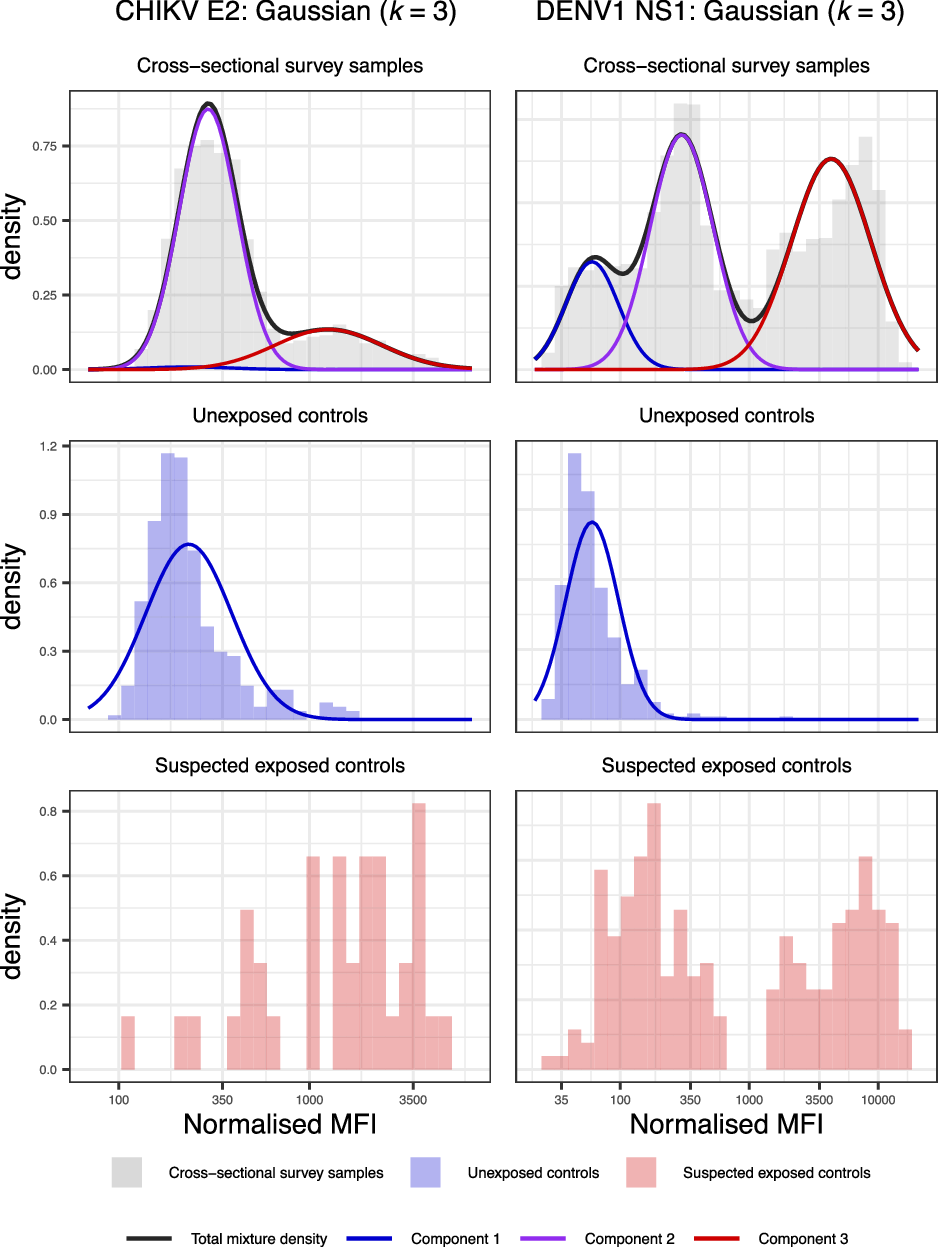
Accurate serological tools are essential for monitoring the transmission of arboviruses with pandemic potential, yet cross-reactivity between closely related viruses hampers diagnostics and surveillance. Here, we develop a high-throughput multiplex serological assay to quantify antibody responses to 28 antigens from nine arboviruses (dengue, Zika, yellow fever, West Nile, Usutu, Japanese encephalitis, chikungunya (CHIKV), Mayaro (MAYV), and O’nyong-nyong virus) and apply it to over 4000 samples from epidemiologically distinct sites on four continents. We implement a flexible analytical method based on Bayesian finite mixture models and Receiver Operating Characteristic analysis to evaluate assay performance and define seropositivity thresholds. As a case study, we resolve cross-reactive and virus-specific responses for CHIKV and the emerging MAYV by combining competitive immunoassays with mathematical modelling of multiplex serological and epidemiological data. This approach yields cross-reactivity-adjusted estimates of local transmission dynamics, in agreement with existing epidemiological evidence, and reveals that CHIKV is more prone to induce cross-reactive antibody responses than MAYV. Our results demonstrate the power of combining multiplex serology with experimental validation and modelling to disentangle exposure histories in the face of serological cross-reactivity. This integrative approach holds promise for improving arbovirus surveillance, particularly in settings with overlapping transmission of multiple viruses and limited diagnostic capacity.