2026-04-15 韓国基礎科学研究院(IBS)
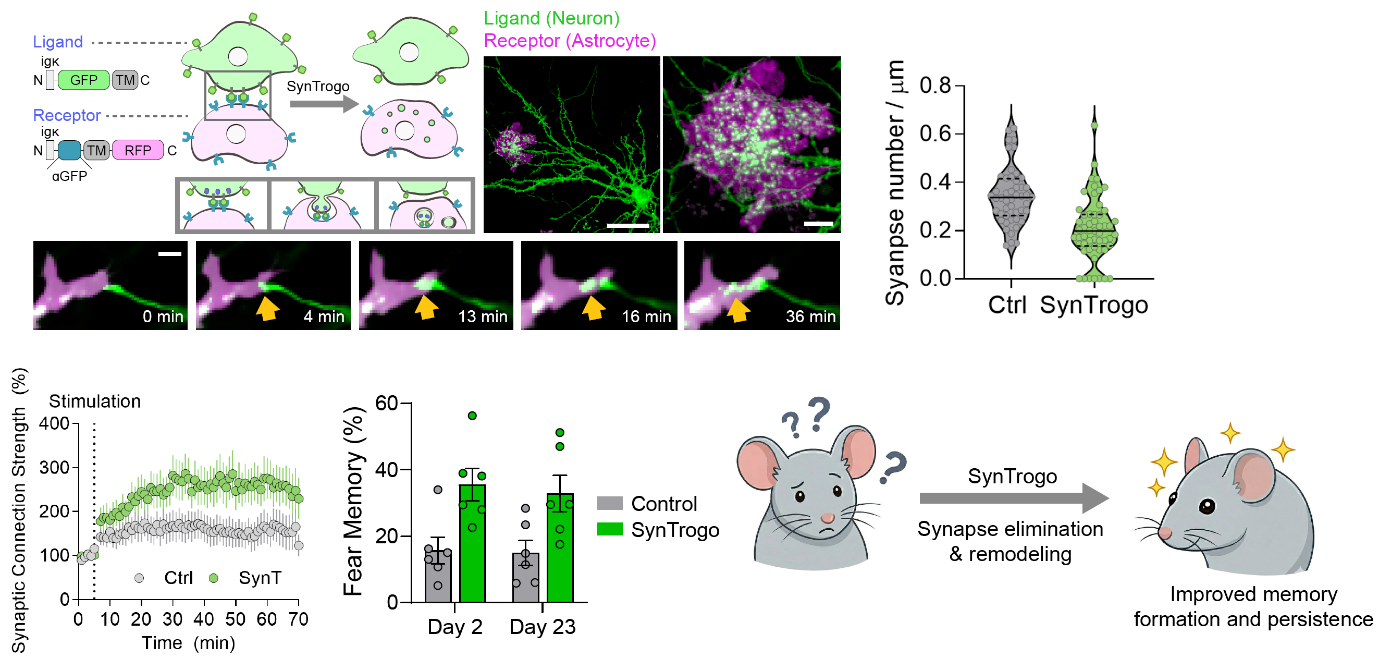
Figure 1. Synthetic Trogocytosis (SynTrogo) enables the “nibbling” of neuronal membranes by astrocytes through engineered ligand and receptor proteins. Upon SynTrogo induction, the synaptic density of the target CA3-CA1 hippocampal circuit was significantly reduced by ~27%. Conversely, the remaining synapses underwent structural and functional remodeling – characterized by the enlargement of pre- and post-synaptic compartments, enhanced long-term potentiation (LTP), and improved memory formation and retention.
<関連情報>
- https://www.ibs.re.kr/cop/bbs/BBSMSTR_000000000738/selectBoardArticle.do?nttId=26637&pageIndex=1&searchCnd=&searchWrd=
- https://www.nature.com/articles/s41467-026-71440-w
人工的に操作されたニューロンとアストロサイトの相互作用によるシナプス結合の再構築 Remodeling synaptic connections via engineered neuron-astrocyte interactions
Shin Heun Kim,Woojin Won,Gyu Hyun Kim,Yeon Hee Kook,Seungkyu Son,Songhee Choi,Dong Yeop Kang,Mingu Gordon Park,Young-Jin Choi,Seong Su Won,Juhee Shin,Yong Jeong,Kea Joo Lee,C. Justin Lee & Sangkyu Lee
Nature Communications Published:15 April 2026
DOI:https://doi.org/10.1038/s41467-026-71440-w
Abstract
Information flow through synapses in the central nervous system is regulated by both rapid electrochemical activity and slower structural remodeling. While technological advances allow precise manipulation of synaptic activity, methods for structural remodeling remain limited. Here, we present SynTrogo (Synthetic Trogocytosis), a synthetic molecular approach for modulating synaptic connections. By engineering complementary ligand and receptor proteins, we enable physical interaction between two defined cell populations in culture, leading to a trogocytosis-like process in which receptor-expressing cells internalize membrane fragments and adjacent cytosolic material from ligand-expressing cells. Applying SynTrogo to hippocampal CA3 neurons and CA1 astrocytes in adult male mice results in ultrastructural changes at axon-astrocyte interfaces, accompanied by significantly reduced synaptic connectivity. The remaining synapses exhibit coordinated pre- and post-synaptic structural changes and reorganization of synaptic components and organelles, and are associated with enhanced synaptic plasticity and memory performance. These findings suggest that neural circuits can undergo adaptive reshaping under conditions of synaptic reduction and may provide a foundation for editing synaptic architecture with therapeutic potential for connectopathies.