2026-04-15 中国科学院(CAS)
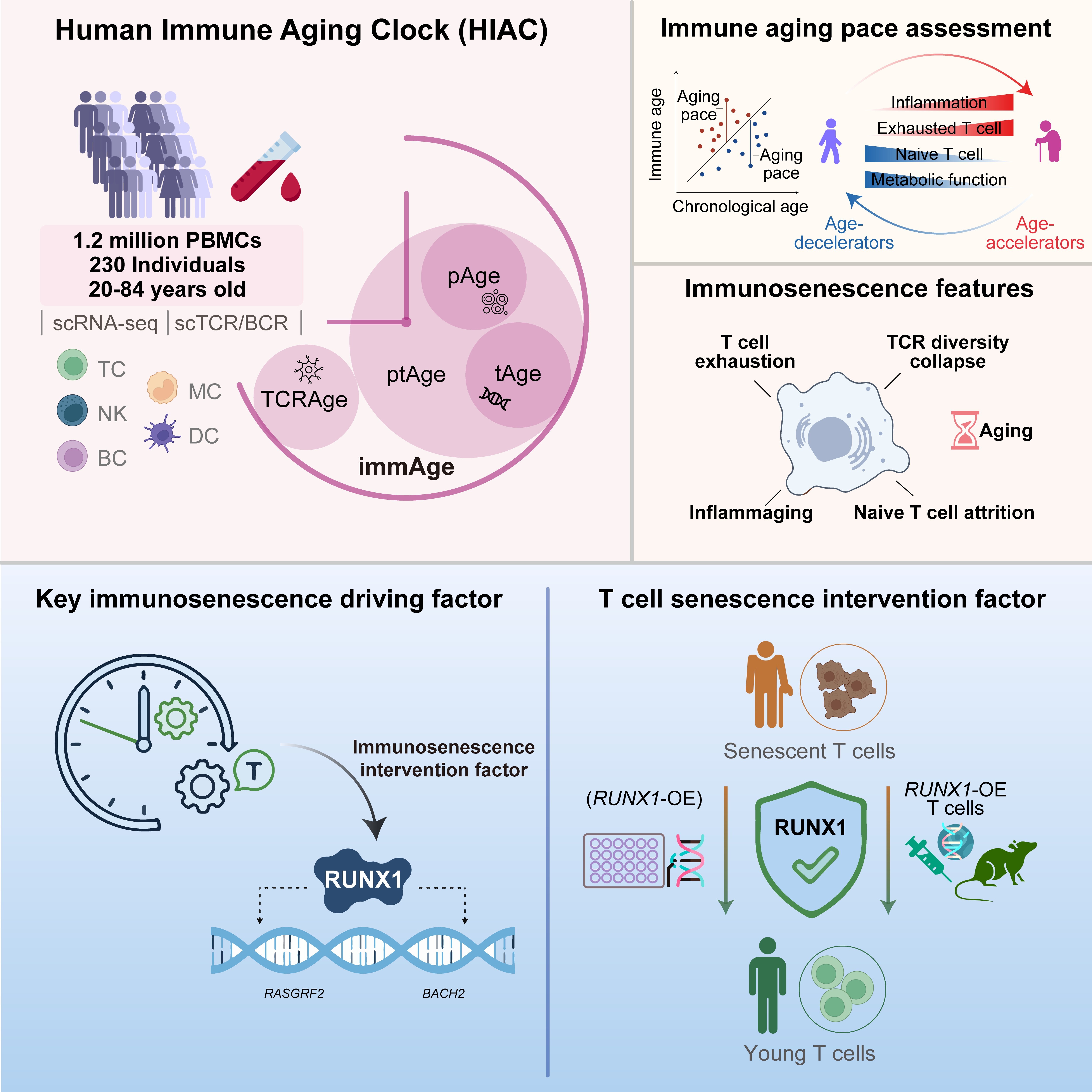
Human immune aging clock identifies RUNX1 as a decelerator of T cell senescence. (Image by ZHANG Weiqi)
<関連情報>
- https://english.cas.cn/newsroom/research-news/202604/t20260415_1156320.shtml
- https://www.cell.com/immunity/abstract/S1074-7613(26)00077-4
ヒト免疫老化時計は、RUNX1がT細胞老化の減速因子であることを特定する Human immune aging clock identifies RUNX1 as a decelerator of T cell senescence
Jiale Ping ∙ Qin Qiao ∙ Dan-Dan Gao ∙ … ∙ Feng Zhang ∙ Guang-Hui Liu ∙ Weiqi Zhang
Immunity Published: April 14, 2026
DOI:https://doi.org/10.1016/j.immuni.2026.02.007
Highlights
- We establish an immune aging clock linked to systemic physiological health
- T cells constitute an aging nexus, with RUNX1 decline across subsets
- RUNX1 orchestrates a pro-youthful gene network to restrain T cell senescence
- Restoring RUNX1 functionally rejuvenates aged human T cells
Summary
Immunosenescence drives organismal aging, yet quantifying its heterogeneity to uncover therapeutic targets remains challenging. We construct a human immune aging clock from single-cell multi-omics data of nearly 1.2 million human peripheral blood mononuclear cells from 230 individuals, precisely mapping immune aging. T cell (TC) transcriptomes are key predictors, revealing hallmarks such as naive cell loss and clonal contraction. This framework identifies the transcription factor RUNX1, whose expression declines with age in TCs, as a central regulator. Functional studies demonstrate that RUNX1 deletion in young TCs induces senescence, while its restoration in aged CD8+ TCs alleviates senescent phenotypes in vitro and in vivo. Our study provides a quantitative tool for assessing immunosenescence and nominates RUNX1 as a target for rejuvenating aged immunity.