2026-04-15 ワシントン州立大学(WSU)
<関連情報>
- https://news.wsu.edu/press-release/2026/04/15/rapid-melatonin-test-can-help-astronauts-and-others-easily-monitor-their-biological-rhythm/
- https://pubs.rsc.org/en/content/articlelanding/2026/nh/d5nh00853k
ヒト血液中のメラトニン検出のための、ユーロピウムナノ粒子標識/ラテラルフローテストストリップと3Dプリント蛍光スマートフォンリーダーの統合 Europium nanoparticle label/lateral flow test strip integrated with a 3D-printed fluorescence smartphone reader for detection of melatonin in human blood
Zhansen Yang, Xinyi Li, Hans P. A. Van Dongen, Yuehe Lin, Yang Song and Dan Du
Nanoscale Horizons Published:11 Mar 2026
DOI:https://doi.org/10.1039/D5NH00853K
Abstract
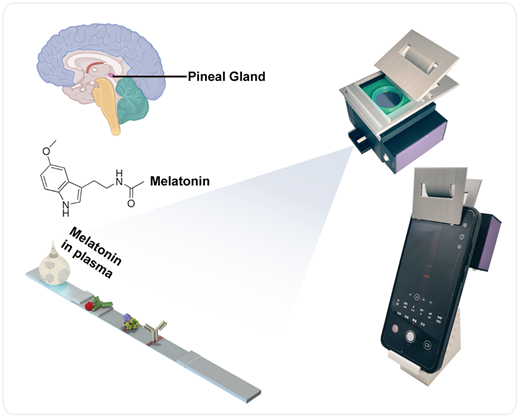
Melatonin secretion by the pineal gland occurs predominantly at night, although ocular exposure to bright light suppresses its secretion. When measured under dim light conditions, the melatonin concentration in plasma provides a reliable indicator of the state of an individual’s central circadian pacemaker in the hypothalamus. Specifically, the onset of melatonin secretion in the evening, conventionally defined as the time when the plasma concentration surpasses a threshold of 10 pg mL−1, serves as a gold-standard measure of the start time of physiological night. Current melatonin detection methods typically require expensive assays and instrumentation as well as trained personnel, or they lack sufficient sensitivity and anti-interference capabilities, which limit their use in point-of-need settings. To address these challenges, we developed a europium nanoparticle-based lateral flow immunoassay (EuNP-LFIA) integrated with a 3D-printed smartphone-based fluorescence reader for on-site melatonin detection in plasma. Six key parameters, namely readout time, EuNP size, antibody conjugation level, Tween-20 concentration, EuNP deposition volume, and the concentration of melatonin–bovine serum albumin on the nitrocellulose membrane, were systematically optimized. Upon optimization, the sensing platform exhibited highly sensitive detection of melatonin in buffer solution and achieved a limit of detection (LOD) of 9.99 pg mL−1. For melatonin-spiked plasma samples, the recovery rates ranged from 82.58% to 114.70%, indicating excellent repeatability and reliability. Overall, the proposed method possesses high sensitivity and accuracy, offering a portable, rapid (<15 min), cost-effective, and user-friendly solution for real-time monitoring of plasma melatonin.