2026-04-28 中国科学院(CAS)
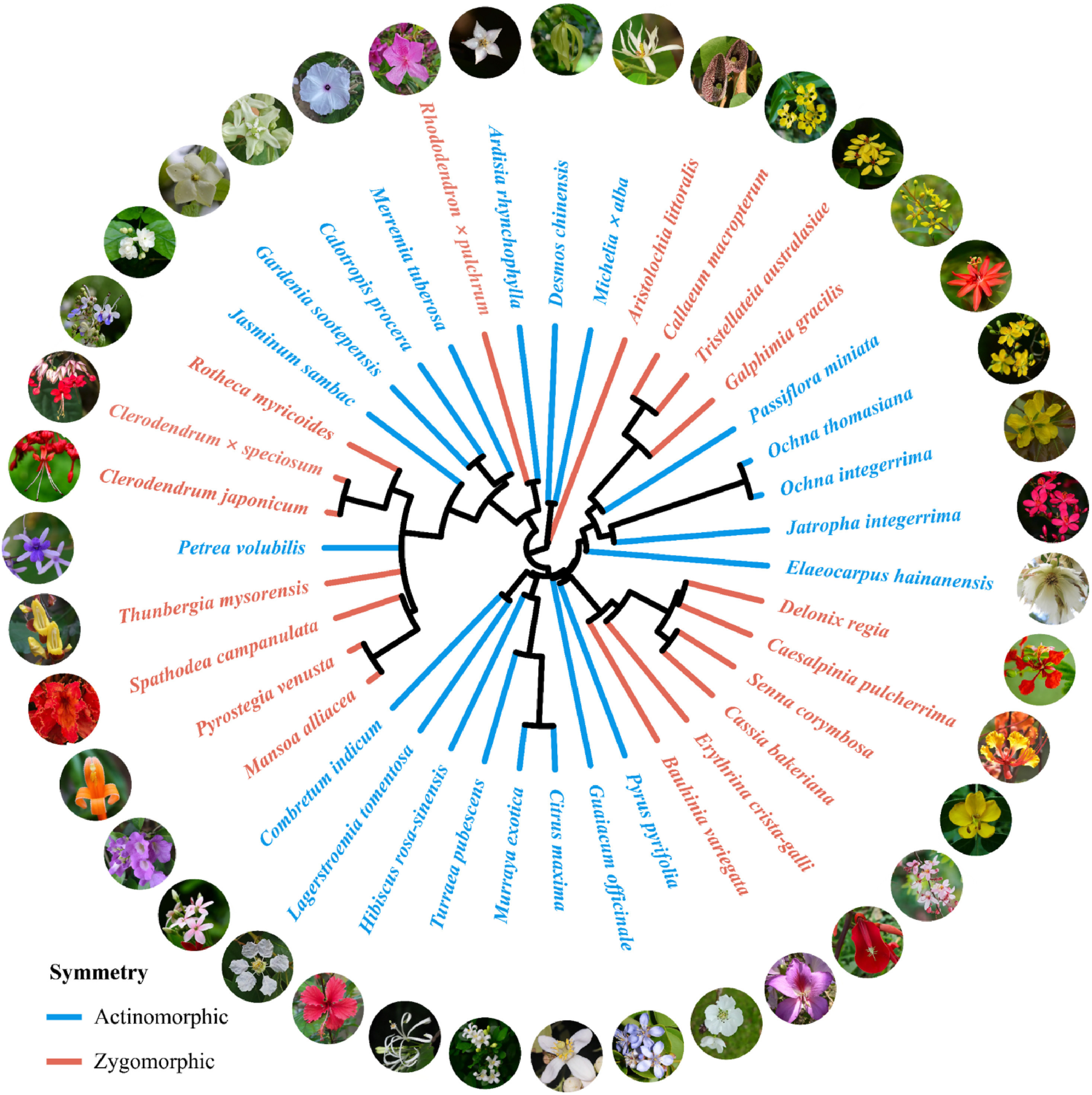
Actinomorphic (radially symmetrical) flowers and zygomorphic (bilaterally symmetrical) flowers. (Image by XTBG)
<関連情報>
- https://english.cas.cn/newsroom/research-news/202604/t20260430_1158279.shtml
- https://www.sciencedirect.com/science/article/pii/S2468265926000855
花の対称性は、被子植物の花における対照的な水分輸送戦略と形質の協調に関連している Floral symmetry is associated with contrasting hydraulic strategies and trait coordination in angiosperm flowers
Feng-Jiao Liu, Yan Ke, Xian-Yan Huang, Yun-Bing Zhang, Jiao-Lin Zhang
Plant Diversity Available online: 7 April 2026
DOI:https://doi.org/10.1016/j.pld.2026.04.001
Highlights
- Floral symmetry is associated with distinct hydraulic architectures and water-use strategies.
- Zygomorphic flowers adopt conservative hydraulic strategies, while actinomorphic flowers rely on high vein density.
- Zygomorphic flowers exhibit tighter hydraulic trait coordination and integration.
Abstract
Floral symmetry is widely recognized as a key driver of angiosperm diversification, yet how actinomorphic and zygomorphic flowers differ in their hydraulic architecture remains poorly understood. Clarifying symmetry-related differences in hydraulic strategies is essential for linking floral function with physiological and evolutionary divergence. Here, we measured 22 floral traits related to hydraulics, structural and reproductive investment across 39 woody species (21 actinomorphic and 18 zygomorphic) to evaluate how floral symmetry shapes hydraulic design. Our results revealed distinct hydraulic differentiation between the two symmetry types. Zygomorphic flowers exhibited significantly longer floral longevity (FL) and lower petal vein density (Dvein) than actinomorphic flowers. They also adopted a hydraulically safer strategy, characterized by more negative water potential at the turgor loss point (ψtlp), lower relative water content at turgor loss (RWCtlp), and higher hydraulic capacitance (C1,mass). Crucially, after accounting for native climatic variables, divergence in FL, ψtlp, and Dvein remained significant, indicating that these traits represent intrinsic features of floral symmetry, whereas C1,mass and RWCtlp function primarily as environmentally plastic responses. Functionally, actinomorphic flowers prioritized hydraulic supply capacity, whereas zygomorphic flowers combined enhanced hydraulic safety with extended longevity. Furthermore, zygomorphic flowers showed stronger trait coordination, forming integrated functional modules that likely contribute to greater hydraulic stability under fluctuating environmental conditions. Together, these findings demonstrate that floral symmetry is tightly linked to physiological function and that evolutionary shifts in symmetry may be accompanied by coordinated adjustments in hydraulic safety as well as structural and reproductive investment, thereby supporting divergent pollination strategies and life-history demands.