2026-05-07 ペンシルベニア州立大学(Penn State)
<関連情報>
- https://www.psu.edu/news/research/story/digital-therapy-outperforms-referrals-campus-clinics-among-college-students
- https://www.nature.com/articles/s41562-026-02454-z
大学生の不安、うつ病、摂食障害に対するデジタル認知行動療法に基づくセルフヘルプ介入の集団ベースのランダム化比較試験 Population-based RCT of a digital cognitive-behavioural guided self-help intervention for anxiety, depression and eating disorders in college students
Michelle G. Newman,Ellen E. Fitzsimmons-Craft,Seung Yeon Baik,Nur Hani Zainal,Adam Calderon,Gavin N. Rackoff,Marie-Laure Firebaugh,Elsa Rojas-Ashe,Yan Leykin,Daphne Lew,Daniel Eisenberg,C. Barr Taylor & Denise E. Wilfley
Nature Human Behaviour Published:07 May 2026
DOI:https://doi.org/10.1038/s41562-026-02454-z
Abstract
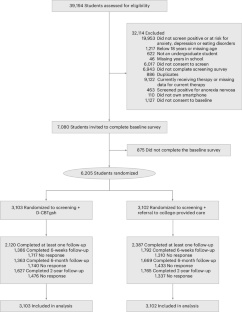
Scalable approaches such as digital cognitive-behavioural therapy guided self-help (D-CBTgsh) may help close the treatment gap for college students with mental disorders. In a randomized clinical trial (ClinicalTrials.gov: NCT04162847) across 26 US colleges, populations were offered a mental health screen (39,194 assessed). Students with clinical levels or high risk for anxiety, depression and/or eating disorders (N = 6,205) were randomized to screening+D-CBTgsh or screening+referral-to-college-provided-care groups. Screening+D-CBTgsh reduced prevalence of any mental disorder (primary outcome) at 6 weeks (odds ratio (OR) = 0.80, 95% CI = 0.70–0.91), 6 months (OR = 0.77, 95% CI = 0.68–0.88) and 2 years (OR = 0.82, 95% CI = 0.72–0.93). Services uptake was greater in screening+D-CBTgsh (74.4%) versus screening+referral (30.2%) at 6 months (OR = 6.72, 95% CI = 6.01–7.52) and 2 years (OR = 1.83, 95% CI = 1.64–2.04), including for minoritized groups. Screening+D-CBTgsh (versus screening+referral to college-provided care) also improved dimensional outcomes of generalized anxiety, social anxiety, depression, eating disorder symptoms and mental health functioning. Findings supported transdiagnostic prevention and intervention benefits of screening+D-CBTgsh and its viability as a scalable, population-based approach.