2026-05-11 東京科学大学
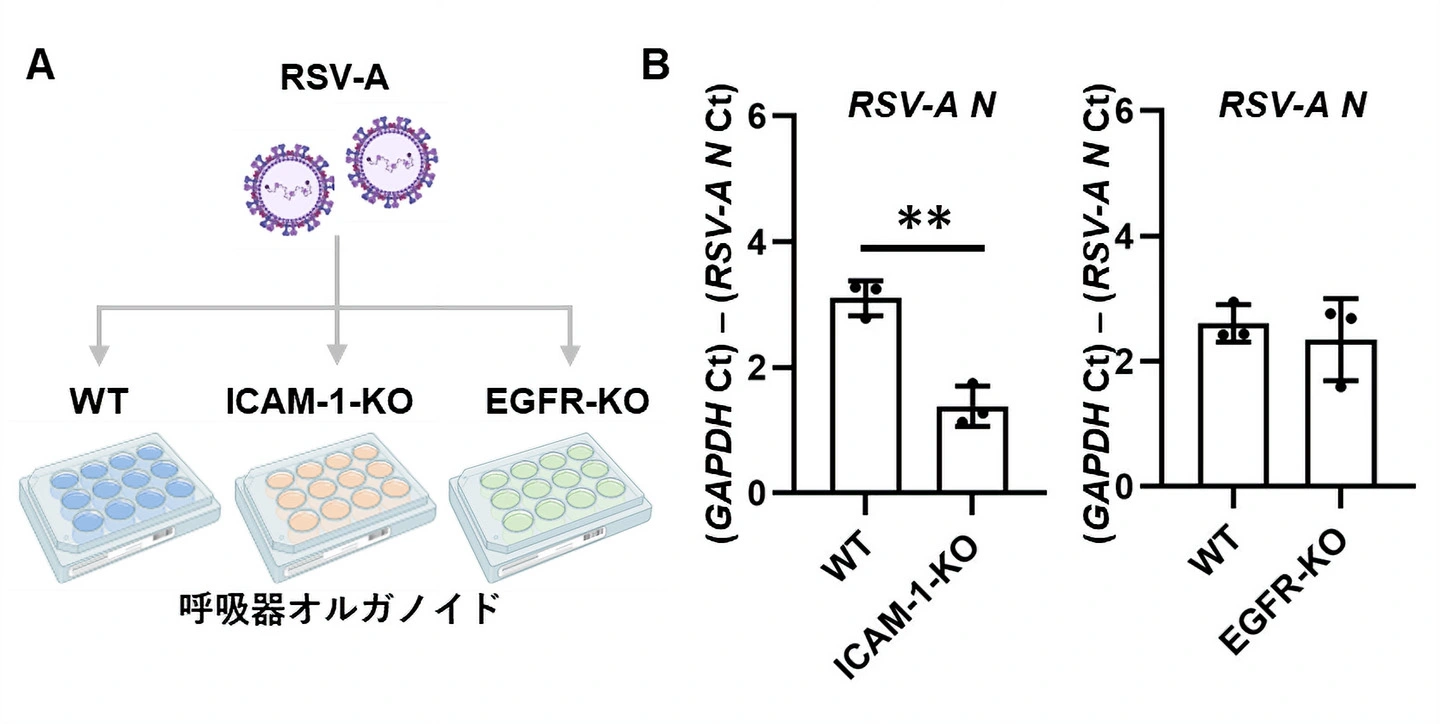
図1.(A)ICAM-1およびEGFRを欠損(KO)させた呼吸器オルガノイドと野生型(WT)呼吸器オルガノイドにRSウイルスを感染させた。
(B)感染96時間後に、RSウイルスヌクレオカプシド(N)遺伝子の発現量を解析した。**p<0.01。
<関連情報>
- https://www.isct.ac.jp/ja/news/c7aqwg49hbmo#top
- https://www.cell.com/molecular-therapy-family/nucleic-acids/fulltext/S2162-2531(26)00103-4
細胞間接着分子-1とヌクレオリンの二重阻害は、ヒト呼吸器オルガノイドにおけるRSV感染効率を低下させる Dual inhibition of intercellular adhesion molecule-1 and nucleolin reduces RSV infection efficiency in human respiratory organoids
Abeer Keshta ∙ Rina Hashimoto ∙ Yuki Kitai ∙ … ∙ Shimpei Gotoh ∙ Makoto Takeda ∙ Kazuo Takayama
Molecular Therapy Published:April 17, 2026
DOI:https://doi.org/10.1016/j.omtn.2026.102932
Abstract
Respiratory syncytial virus (RSV) is one of the major causes of lower respiratory tract infections, particularly in infants and older adults. However, the host factors mediating infection remain poorly defined. It has been suggested that four host surface proteins, namely intercellular adhesion molecule-1 (ICAM-1), epidermal growth factor receptor (EGFR), nucleolin (NCL), and insulin-like growth factor 1 receptor (IGF1R), may interact with the RSV fusion (F) protein. To investigate these roles under physiologically relevant conditions, we employed human induced pluripotent stem cell (iPSC)-derived respiratory organoids as a model for RSV infection. In this model, ICAM-1 and EGFR were genetically depleted using the CRISPR-Cas9 genome editing technique, while NCL and IGF1R were inhibited with neutralizing antibodies. Suppression of ICAM-1 or NCL significantly reduced RSV nucleoprotein gene expression, whereas inhibition of EGFR or IGF1R had no observable effect on viral gene expression. Notably, simultaneous suppression of ICAM-1 and NCL resulted in a more substantial reduction in infectious viral titers and RSV F protein expression than inhibition of either protein alone. Our results suggest that both ICAM-1 and NCL may play important roles during RSV infection in human iPSC-derived respiratory organoids.