2026-05-14 東北大学
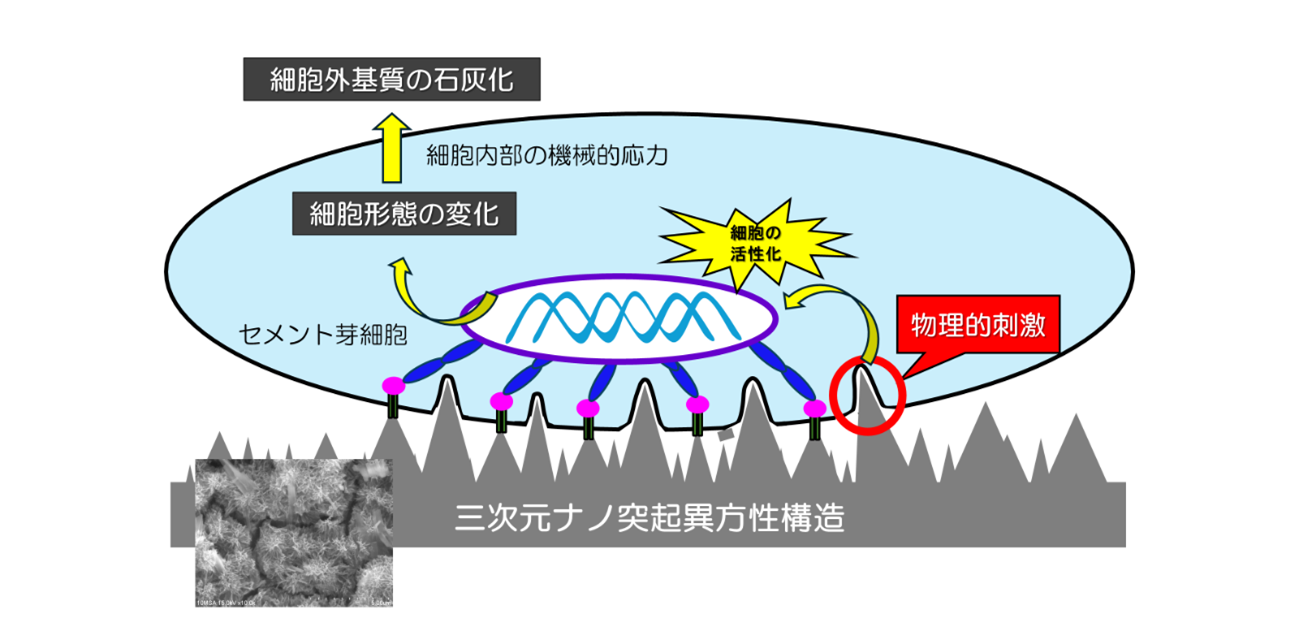
図1. 三次元ナノ突起異方性構造の物理的接触刺激によるセメント芽細胞石灰化制御の概要
<関連情報>
- https://www.tohoku.ac.jp/japanese/2026/05/press20260514-05-nanospike.html
- https://www.sciencedirect.com/science/article/abs/pii/S0109564126002733
異方性三次元チタンナノスパイク構造は、生物物理学的シグナルを介してヒトセメント芽細胞様細胞のマトリックス鉱化を促進する Anisotropic three-dimensional titanium nanospike architectures drive matrix mineralization of human cementoblast-like cells through biophysical cues
Kippei Ogumi, Masahiro Yamada, Koki Otake, Takayuki Ohtake, Jun Watanabe, Hiroshi Egusa
Dental Materials Available online: 29 April 2026
DOI:https://doi.org/10.1016/j.dental.2026.04.012
Highlights
- 3D anisotropically distributed titanium nanospikes enhanced human cementoblast-like cell mineralization.
- Nanoscale architecture, not surface chemical properties, governed matrix mineralization.
- Physical stimulation by nanospikes generated distinctive mechanotransduction signatures.
- Rounded cell morphological changes predicted cementoblastic matrix mineralization.
- 3D nanoscale architecture may also influence other physical surface properties.
Abstract
Objective
Regenerating cementum remains a major unmet challenge in periodontal and peri-implant therapy, underscoring the need to understand how cementoblasts respond to engineered surface cues. This study examined the manner in which titanium nanosurfaces integrating anisotropic nanopatterns with three-dimensional (3D) nanospike architectures regulate mechanotransduction and matrix mineralization in human cementoblast-like cells (hCEM).
Methods
Titanium surfaces with isotropic, anisotropic, and 3D anisotropic nanospike architectures were fabricated and characterized through quantitative analyses of nanoscale geometry and topographical organization. Surface chemistry and crystallinity were characterized using Fourier transform infrared spectroscopy, grazing-incidence X-ray diffraction, and X-ray photoelectron spectroscopy. hCEM cultures on each surface were evaluated for extracellular calcium (Ca) and phosphate (P) levels, Ca/P ratios, extracellular matrix crystallinity, cytomorphology, and phosphate metabolism-associated gene expression. Mechanotransduction activity was assessed through focal adhesion–Hippo pathway signaling. Relationships between nanoscale architecture, cell stimulation, morphology, and mineralization were examined using correlation and path analyses.
Results
Despite comparable wettability and oxide chemistry to that of other nanosurfaces, 3D anisotropic nanospike surfaces produced the highest mineralization and exhibited the highest Ca/P ratios, clear hydroxyapatite signatures, pronounced extracellular nodules, and coordinated activation of phosphate metabolism gene profiles. These surfaces induced prominent nanoscale vertex–cell interactions and distinct cytomorphological responses. Mineralization did not show association with vertical roughness, hydroxyl content, or crystallographic features but positively correlated (r = 0.94) with composite nanoscale architectural metrics capturing spatial heterogeneity and vertex density.
Significance
The finding that anisotropic 3D nanospike architectures are associated with enhanced matrix mineralization in human cementoblast-like cells under osteogenic conditions provides mechanistic insight into how nanoscale architecture modulates mineralization responses and may inform the design of cementum-targeted bioactive titanium surfaces.